
Kinematics
It is the branch of mechanics which deals with the study of the motion of the body without its cause.
Motion
A body is said to be in motion if it changes its position with respect to surrounding.
Rest
A body is said to be in rest if it does not change its position with respect to surrounding.
Distance
The length of actual path travelled by the body between its initial and final position is called distance. It is a scalar quantity. The unit of distance in SI or M.K.S. system is meter and its unit in CGS system is centimeter.
Displacement
The shortest distance between two points in specified direction is called displacement. It is a vector quantity.

In fig. (1), path 3 is a displacement. The unit of displacement is same as that of distance.
Speed
The distance travelled by the body in per unit time is called speed. i.e.
It is a scalar quantity.
The unit of speed is in SI or MKS system is m/s and its unit in CGS system is cm/s.
Velocity
The distance of change of displacement of the body is called velocity. i.e.
It is a vector quantity. Its unit is same as that of speed.
Types of velocity
Types of velocity
- Uniform velocity
A body is said to be in uniform velocity if it travels or undergoes equal displacement in equal interval of time.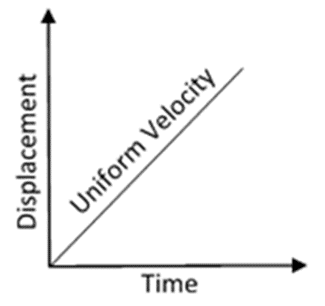
- Variable Velocity
A body is said to be moving with variable velocity if it travels equal displacement in unequal interval of time or vice versa.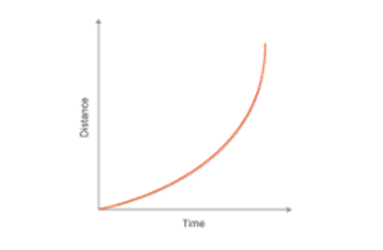
- Average Velocity
An average velocity of a body, moving with variable velocity is defined as the ratio of its displacement to the time interval during which this displacement occurs.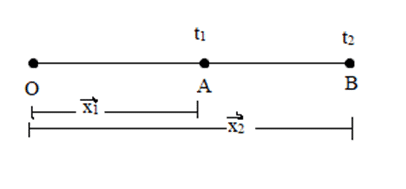
Let, [latex]\vec{x_1}[/latex] and [latex]\vec{x_2}[/latex] be the displacement of a body in time t1 and t2 respectively at point A and B as shown in figure, then, according to the definition of average velocity, we can write,
Average velocity = [latex]\frac{\vec{x_2}-\vec{x_1}}{t_2-t_1}[/latex]
= [latex]\frac{\Delta \vec{x}}{\Delta t}[/latex]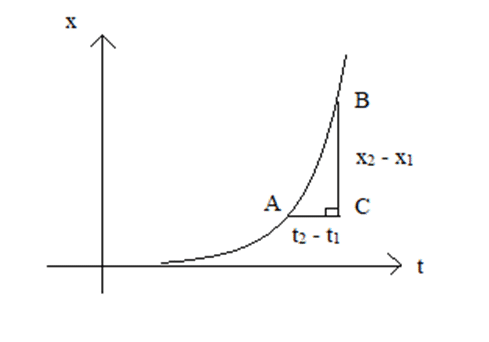
Slope = [latex]\frac{BC}{AC}[/latex]
= [latex]\frac{\vec{x_2}-\vec{x_1}}{t_2-t_1}[/latex]
= [latex]\frac{\Delta x}{\Delta t} = v[/latex]


Instantaneous velocity
Instantaneous velocity of a body, moving with variable velocity, at a particular time is defined as velocity of the body at that particular time.

Mathematically,
Instantaneous velocity is written as,
Instantaneous velocity [latex](\vec{v}) = \lim_{\Delta t \to 0} \frac{\Delta \vec{x}}{\Delta t}[/latex]
Acceleration
The rate of change of velocity of the body is called acceleration. i.e.
Acceleration = [latex]\frac{v}{t}[/latex].
It is a vector quantity. Its unit in SI system is m/s2 and its unit in CGS system is cm/s2. Dimension of acceleration is [MoL1T-2].
Types of acceleration
1. Uniform acceleration:
A body is said to be moving with uniform acceleration if it changes its velocity by equal amount in equal interval of time.

2. Variable acceleration
A body is said to be moving with variable acceleration if it changes its velocity by equal amount in unequal interval of time.

3. Average Acceleration
An average acceleration of a body moving with variable acceleration is defined as the ratio of the change in velocity of the body to the time interval during which this change in velocity occur.

According to the definition of average acceleration, we can write,
Average acceleration [latex](\vec{a}) = \frac{\vec{v_2}-\vec{v_1}}{t_2 – t_1}[/latex]
= [latex]\frac{\Delta \vec{v}}{\Delta t}[/latex]
Slope = [latex]\frac{BC}{AC}[/latex]
= [latex]\frac{v_2 – v_1}{t_2 – t_1} = \frac{\Delta v}{\Delta t}[/latex]
= Average acceleration
4. Instantaneous Acceleration
Instantaneous acceleration of a body, moving with variable acceleration at a particular time is defined as the acceleration of the body at that particular time.

Mathematically, Instantaneous acceleration is written as,
Instantaneous acceleration [latex](\vec{a}) = \lim_{\Delta t \rightarrow 0}\frac{\Delta v}{\Delta t} = \frac{d\vec{v}}{dt}[/latex]

Note: Retardation
Negative acceleration is called retardation.
Equation of motion of a body moving with uniform acceleration (From Graphical method)
Let us consider, a body which is moving with uniform acceleration along straight line. Let, u be the initial velocity of the body at time t = 0 and v be the final velocity of the body after time (t).
From Fig., we can write,

OA = DC = u, OE = DB = v and AC = OD = t.
1) v = u + at
We know that,
Acceleration (a) = slope of line AB in velocity time (v-t) graph
= [latex]\frac{BC}{AC}[/latex]
= [latex]\frac{v-u}{t}[/latex]
Or, at = v – u
[latex]\therefore[/latex] v = u + at …………….. (i)
In velocity time graph, area of parallelogram, area of rectangle and area of trapezium gives distance.
2) S = [latex]ut+\frac{1}{2}at^2[/latex]
We know that, distance (S) travelled by the body in time t = area of trapezium OABD
= Area of rectangle OACD + Area of [latex]\Delta[/latex]ABC
= OA x AC + [latex]\frac{1}{2}AC\times BC[/latex] ……………… (ii)
S = u x t + [latex]\frac{1}{2}t.BC[/latex]
Again, a = [latex]\frac{BC}{AC}[/latex]
Or, at = BC ……………… (iii)
Putting BC = at in equation (ii), we get,
S = ut + [latex]\frac{1}{2}t\times at[/latex]
Or, S = ut + [latex]\frac{1}{2}at^2[/latex] …………….. (iv)
3) v2 = u2 + 2as
We know that,
Distance (S) travelled by the body in time (t) = Area of trapezium OABD
= [latex]\frac{1}{2}(OA+DB)\times AC[/latex]
= [latex]\frac{1}{2}(u+v)\times AC[/latex] …………….. (v)
Again, a = [latex]\frac{BC}{AC}=\frac{v-u}{AC}[/latex]
Or, AC = [latex]\frac{v-u}{a}[/latex] ……………….. (vi)
On putting the value of AC from eqn. (vi) into eqn. (v), we get,
S = [latex]\frac{1}{2}(u+v)\times \frac{v-u}{a}[/latex]
S = [latex]\frac{1}{2}\frac{v^2-u^2}{a}[/latex]
Or, 2us = v2 – u2
Or, u2 + 2as = v2
Or, v2 = u2 + 2as …………….. (vii)
Note: If the body is started to move from rest, then, initial velocity (u) = 0.
Equation of Motion of freely falling body
1. When the body is thrown in upward direction (neglecting the air resistance) then,
Acceleration of the body is (-g) i.e. a = -g
Then, equation of motion of that body is written as

1) v = u – gt
2) h = ut – [latex]\frac{1}{2}gt^2[/latex]
3) v2 = u2 – 2gh
2. When the body is thrown / dropped from a certain height, then, acceleration of the body is +g i.e. a = +g, then, equation of motion of that body is written as,

1) v = u + gt
2) h = ut + [latex]\frac{1}{2}gt^2[/latex]
3) v2 = u2 + 2gh
Distance travelled by the body in tth second
Let us consider, a body which is moving with uniform acceleration (a) along straight line. Let, St be the distance travelled by the body in time ‘t’ is written as:
St = ut + [latex]\frac{1}{2}at^2[/latex] …………………….. (1)
And, St – 1 be the distance travelled by the body in time (t-1) is given by:
S(t-1) = u(t-1) + [latex]\frac{1}{2}a(t-1)^2[/latex] …………………… (2)
Therefore, distance travelled by the body in tth second = St – S(t-1)
Sth = ut + [latex]\frac{1}{2}at^2 – u(t-1)-\frac{1}{2}a(t-1)^2[/latex]
= ut + [latex]\frac{1}{2}at^2-ut+u-\frac{1}{2}a(t^2-2t+1)[/latex]
= ut + [latex]\frac{1}{2}at^2-ut+u-\frac{1}{2}at^2+at-\frac{1}{2}a[/latex]
= ut + [latex]at-\frac{1}{2}a[/latex]
= [latex]u+\frac{2at}{2}-\frac{a}{2}[/latex]
Sth = u + [latex]\frac{a}{2}(2t-1)[/latex]
Projectile
If a body is thrown into atmosphere (space) then, it moves under the action of gravity alone. For e.g.

1) a stone is thrown from height
2) a bomb is dropped from flying airplane
Note:
1) Path of the projectile is trajectory.
2) Projectile is the example of two dimension.
3) Two dimensions → If the body travelled two perpendicular distances in any particular time is called two dimensions.
Projectile fired at certain angle with horizontal

Let us consider, a body is thrown or projected at angle [latex]\theta[/latex] with horizontal, with initial velocity [latex](\vec{u})[/latex]. An initial velocity [latex](\vec{u})[/latex] is resolved or divided into horizontal component and vertical components as (ux) = uCos[latex]\theta[/latex] and uy = uSin[latex]\theta[/latex] respectively as shown in figure (1).
After time (t), the body reached at point P and each co – ordinate is P(x,y). Now, the horizontal distance ‘x’ travelled by the body in time (t) is:
x = uxt + [latex]\frac{1}{2}a_xt^2[/latex]
Since, ax = 0, then,
x = uCos[latex]\theta t + \frac{1}{2}.0.t^2[/latex]
Or, x = uCos[latex]\theta t + 0[/latex]
Or, t = [latex]\frac{x}{ucos\theta}[/latex] ………………… (i)
And, vertical distance ‘y’ travelled by the body in time ‘t’ is:
y = uyt + [latex]\frac{1}{2}a_yt^2[/latex]
Or, y = uSin[latex]\theta t + \frac{1}{2}a_yt^2[/latex]
Or, y = uSin[latex]\theta t + \frac{1}{2}at^2[/latex]
Or, y = uSin[latex]\theta t – \frac{1}{2}gt^2[/latex] ………………… (ii) [∵a = ay and a = -g]
On putting the value of t from eqn. (i) into eqn (ii), we get,
y = uSin[latex]\theta (\frac{x}{ucos\theta}) – \frac{1}{2}g(\frac{x}{ucos\theta})^2[/latex]
Or, y = tan[latex]\theta x – \frac{1}{2}g\frac{x^2}{u^2 cos^2\theta}[/latex] ……………. (3)
This is an equation of parabola.
[latex]\therefore[/latex] Path followed by the body during projectile is parabolic in nature. Path of projectile is called trajectory.
Velocity of body (projectile) after time ‘t’ or resultant velocity

From figure (2), we get,
vR2 = vx2 + vy2
Or, vR = [latex]\sqrt{v_x^2 + v_y^2}[/latex] …………………….. (4)
Now,
vx = ux + axt
Or, vx = uCos[latex]\theta + 0[/latex]
Or, vx = uCos[latex]\theta = u_x[/latex]
⇒ vx = ux = uCos[latex]\theta[/latex] …………………… (5)
Note:
Horizontal component of velocity remains constant during projectile.
And,
vy = uy + ayt
Or, vy = uSin[latex]\theta + at[/latex]
Or, vy = uSin[latex]\theta – gt[/latex] ………………… (6)
vR = [latex]\sqrt{v_x^2 + v_y^2}[/latex]
On putting the value of vx and vy in eqn. (4), we get,
vR = [latex]\sqrt{(ucos\theta)^2 + (usin\theta – gt)^2}[/latex] (7)
vR = [latex]\sqrt{u^2cos^2\theta + u^2sin^2\theta – 2usin\theta gt + g^2t^2}[/latex]
Direction of resultant velocity
Let, [latex]\phi[/latex] be the angle made by resultant (vector) velocity with horizontal, then, we can write,
tan[latex]\phi = \frac{v_y}{v_x}[/latex]
Or, tan[latex]\phi = \frac{usin\theta – gt}{ucos\theta}[/latex]
Or, [latex]\phi = tan^{-1}(\frac{usin\theta – gt}{ucos\theta})[/latex] ………………… (8)
Time of flight:
The time taken or spend by the projectile in air is called time of flight. It is denoted by ‘T’. i.e.
Time of flight (T) = Time of ascending (Ta) + Time of descending (Td) …………………… 8(a)
For, time of ascending, we can write,
vy = 0 (at maximum height)
v = u + at
i.e. uy + ayta = 0
Or, uSin[latex]\theta – gt_a = 0[/latex]
Or, ta = [latex]\frac{usin\theta}{g}[/latex] …………………. (9)
[latex]\therefore[/latex] We can write,
Time of descending (td) = [latex]\frac{usin\theta}{g}[/latex] …………… (10)
On putting the value of ta and td from eqn. (9) and (10) in eqn. (8), we get,
T = [latex]\frac{usin\theta}{g} + \frac{usin\theta}{g}[/latex]
= [latex]\frac{2usin\theta}{g}[/latex] ………………………. (11)
Maximum height (Hmax):

At maximum height, we can write, vy = 0
vy2 = 02
Or, vy2 = 0
Or, uy2 +2ayHmax = 0
Or, [latex](usin\theta)^2 – 2gH_{max} = 0[/latex]
Or, [latex]u^2sin^2\theta = 2gH_{max}[/latex]
[latex]\therefore[/latex] Hmax = [latex]\frac{u^2sin^2\theta}{2g}[/latex] …………….. (12)
Special case:
1) If [latex]\theta = 0^o[/latex], then,
Hmax = [latex]\frac{u^2sin^2\theta}{2g} =0[/latex] (Minimum)
2) If [latex]\theta = 90^o[/latex], then,
Hmax = [latex]\frac{u^2sin^2\theta}{2g} = \frac{u^2}{2g}[/latex] (Maximum)
Horizontal Range (R):
The horizontal distance travelled by the projectile during time of flight is called horizontal range. It is denoted b R.

S = uxT + [latex]\frac{1}{2}at^2[/latex]
R = uCos[latex]\theta(\frac{2usin\theta}{g})+\frac{1}{2}\times 0.T^2[/latex]
= [latex]ucos\theta \times \frac{2usin\theta}{g}[/latex]
= [latex]\frac{2u^2sin\theta cos\theta}{g}[/latex]
[latex]\therefore[/latex] R = [latex]\frac{u^2sin2\theta}{g}[/latex] ……………….. (13)
Special Cases:
1) If [latex]\theta = 0^o, R = \frac{u^2sin2\times 0^o}{g} = 0[/latex] (Minimum)
2) If [latex]\theta = 45^o, R = \frac{u^2sin2\times 45^o}{g} = \frac{u^2}{g}[/latex] (Maximum)
Projectile fired from Certain Height parallel to Horizontal:

Let us consider, a body which is thrown horizontally with initial velocity [latex](\vec{u})[/latex] from height ‘h’ as shown in figure above.
After time ‘t’, the body reached at point P whose co-ordinate (position) is (x,y).
Now, the horizontal distance ‘x’ travelled by a body in time ‘t’ is,
x = uxt + [latex]\frac{1}{2}a_xt^2[/latex]
Or, x = uxt + [latex]\frac{1}{2}\times 0 \times t^2[/latex] [∵ ax = 0]
Or, x = uxt
Or, t = [latex]\frac{x}{u_x}[/latex] …………… (1)
Again, the vertical distance ‘y’ travelled by the body in same time ‘t’ is:
y = uyt + [latex]\frac{1}{2}a_yt^2[/latex]
= [latex]0\times t + \frac{1}{2}gt^2[/latex] [∵ uy = 0]
Or, y = [latex]\frac{1}{2}gt^2[/latex] ……………… (2)
On putting the value of ‘t’ from eqn. (1) into eqn. (2), we get,
y = [latex]\frac{1}{2}g(\frac{x}{u_x})^2[/latex]
Or, y = [latex]\frac{1}{2}g\frac{x^2}{u_x^2}[/latex]
Or, y = [latex]\frac{g}{2u_x^2}\times x^2[/latex]
Or, y = kx2 …………… (3)
Where, k = [latex]\frac{g}{2u_x^2}[/latex] is constant.
Hence, eqn. (3) is the eqn. of parabola. Therefore, path followed by body during projectile is parabolic in nature.
Velocity of body after time ‘t’ or velocity of body at any instant ‘t’ or Resultant velocity:

Let, vR be the resultant velocity of body at any instant ‘t’. From the figure above, we can write,
vR2 = vx2 + vy2
Or, vR = [latex]\sqrt{v_x^2 + v_y^2}[/latex] ……………………. (4)
Now,
vx = ux + axt
Or, vx = ux + 0.t
Or, vx = ux = constant ……………… (5)
Which shows that horizontal component of initial velocity and final velocity remains constant.
And,
vy = uy + ayt
= 0 + gt
Or, vy = gt ……………….. (6)
Then, eqn. (4) becomes,
vR = [latex]\sqrt{u_x^2 + (gt)^2}[/latex]
= [latex]\sqrt{u_x^2 + g^2t^2}[/latex] …………. (7)
Direction of Resultant velocity:
Let, [latex]\theta[/latex] be the angle made by resultant velocity with horizontal, then, from figure, we can write,
tan[latex]\theta = \frac{v_y}{v_x} = \frac{gt}{u_x}[/latex]
Or, [latex]\theta = tan^{-1}(\frac{gt}{u_x})[/latex] ………….. (8)
Time of flight:
It is defined as the total time spend by body or projectile in air.
Then,
h = uyT + [latex]u_yT + \frac{1}{2}a_yT^2[/latex]
Or, h = 0.T + [latex]\frac{1}{2}gT^2[/latex]
Or, h = [latex]\frac{1}{2}gT^2[/latex]
Or, T = [latex]\sqrt{\frac{2h}{g}}[/latex] ……………… (9)
Horizontal Range (R):
It is defined as the horizontal distance travelled by the body or projectile in time of flight.
Then,
R = uxT + [latex]\frac{1}{2}a_xT^2[/latex]
Or, R = uxT + [latex]\frac{1}{2}\times 0.T^2[/latex]
Or, R = uxT
Or, R = ux [latex]\sqrt{\frac{2h}{g}}[/latex] …………………. (10)
Note: vx = ux = u
Relative velocity:
Relative velocity is defined as ”the time rate of change of position of one body with respect to another body when either one body is moving or both bodies are moving.”
The relative velocity of body A with respect to body B is defined by (vAB) and written as:
[latex]\vec{v_{AB}} = \vec{v_A} – \vec{v_B}[/latex]
Derivation of magnitude of relative velocity of one body (A) with respect to body B:

Let A and B are two bodies which are moving with velocity [latex]\vec{v_A}[/latex] and [latex]\vec{v_B}[/latex] respectively and inclined to each other at angle as shown in figure below.
From fig.,
The relative velocity of body A with respect to body B is written as,
[latex]\vec{v_{AB}} = \vec{v_A} + (-\vec{v_B})[/latex]
Now,
vAB2 = [latex]\vec{v_{AB}}.\vec{v_{AB}}[/latex]
= [latex](\vec{v_A} – \vec{v_B}).(\vec{v_A}-\vec{v_B})[/latex]
= [latex]\vec{v_A}.\vec{v_A} – \vec{v_A}.\vec{v_B} – \vec{v_A}.\vec{v_B}+\vec{v_B}[.\vec{v_B}[/latex]
vAB2 = vA2 – [latex]2\vec{v_A}.\vec{B}+v_B^2[/latex]
[latex]v_{AB}^2 = v_A^2 + 2\vec{v_A}(-\vec{v_B}) + \vec{v_B}^2[/latex]
= [latex]v_A^2 + 2|\vec{v_A}||-\vec{B}|cos(180-\theta)+v_B^2[/latex]
[latex]\therefore v_{AB} = \sqrt{v_A^2 – 2v_Av_Bcos\theta + v_B^2}……………….. (1)[/latex]
Special Cases:
1) When body A and body B are moving in same direction, then, [latex]\theta = 0^0[/latex] and eqn. (i) becomes,

[latex]v_{AB} = \sqrt{v_A^2 – 2v_Av_Bcos0^o + v_B^2}[/latex]
Or, [latex]v_{AB} = \sqrt{v_A^2 – 2v_Av_B+v_B^2}[/latex]
Or, [latex]v_{AB} = v_A – v_B[/latex] ……………………. (2)
2) When body A and body B are moving in opposite direction then, [latex]\theta = 180^o[/latex], eqn. (1) becomes,

[latex]v_{AB} = \sqrt{v_A^2 – 2v_Av_Bcos180^o+v_B^2}[/latex]
= [latex]\sqrt{v_A + v_B}[/latex]
[latex]v_{AB} = v_{A} + v_{B}[/latex] ………………………………….. (3)
3) When body A and body B are moving in a direction perpendicular to each other, then, [latex]\theta = 90^o[/latex],

[latex]v_{AB} = \sqrt{v_A^2 – 2 v_A v_Bcos90^o + v_B^2}[/latex]
[latex]v_{AB} = \sqrt{v_A^2 + v_B^2}[/latex] …………………. (4)
Note:
If a man is moving with velocity vm along horizontal and a rain vertically falls with velocity vr, then, magnitude of relative velocity of rain with respect to man is:
vrm = [latex]\sqrt{v_r^2 + v_m^2}[/latex]
Relative velocity of rain with respect to man
Let the rain is falling vertically with velocity and a man is moving horizontally with velocity [latex]\vec{v_m}[/latex], a man can protect himself from the rain if the holds his umbrella in the direction of the relative velocity of rain with respect to man.

Let, [latex]\phi[/latex] be the angle which the direction of relative velocity of rain with respect to man makes with vertical, then, from figure above, we can write,
tan[latex]\phi = \frac{v_m}{v_r}[/latex]
Or, [latex]\phi = tan^{-1}(\frac{v_m}{v_r})[/latex] …………………. (i)
And, the relative velocity of rain with respect to man is:
[latex]\vec{v_{rm}} = \vec{v_r} – \vec{v_m}[/latex]
[latex]\therefore[/latex] Magnitude of the relative velocity of rain with respect to man is: vrm = [latex]\sqrt{v_r^2 + v_m^2}[/latex]