
Refraction of light
When a ray of light passes from one medium to another, it bends from its original direction (or path). The bending of light is called the refraction of light.

Let us consider, a ray of light AO is passing from air to glass, incident at O on the refracting surface XY. In-stead of passing through its original path, it bends through OB. The bending is due to refraction of light.
Why refraction occurs?
When light from rarer medium passes to denser medium, its speed decreases. Similarly, when light from denser medium passes to rarer medium, its speed increases. Due to such sudden change in the speed of light, it bends from its original path and hence, refraction occurs.
Laws of refraction
- The incident ray, normal and the refracted ray all lie on the same plane.
- For two media, the ratio of sine of the angle of incidence (i) to the sine of the angle of refraction (r) always gives a constant value. It is called the refractive index of second medium w.r.t. the first one. i.e.
Refractive index of glass w.r.t. air (aμg) = [latex]\frac{sini}{sinr}[/latex]
Principle of Reversibility of light
Let us consider, light is passing from air to water. A ray of light AO is incident at O between two media, after refraction, it passes through OB. In the figure,

∠AON = Angle of incidence = i &
∠BON’ = Angle of refraction = r. So,
aμw = [latex]\frac{sini}{sinr}[/latex] …………………. (i)
Now, if the ray of light OB is incident at O, making an angle of incidence (r) and after refraction, the ray of light passes through OA making an angle of refraction (i), So,
wμa = [latex]\frac{sinr}{sini}[/latex] …………………… (ii)
from equations (i) and (ii), we get,
aμw . wμa = [latex]\frac{sini}{sinr}\times \frac{sinr}{sini}[/latex]
So, aμw = 1/wμa
This is the principle of reversibility of light.
Refraction through many media
Rarer to Denser: air → Water → glass.
Let us consider, ray of light is passing from air to water, from water to glass and from glass to air as shown in figure.

Let, PQ be the incident ray for air water media, it after refraction passes along QR. For water glass boundary, QR be the incident ray and RS be the refracted ray. But, for glass air boundary, RS acts as incident ray and ST be the refracted ray.
Case 1
For air-water boundary,
∠i = ∠PQN = angle of incidence.
∠r1 = ∠RQN ‘ = angle of refraction.
[latex]\therefore[/latex] refractive index of water w.r.t. air,
aμw = [latex]\frac{sini}{sinr_1}[/latex] ……….. (i)
Case 2
For water-glass boundary,
∠r1 = angle of incidence.
∠r2 = angle of refraction.
[latex]\therefore[/latex] refractive index of glass w.r.t. water,
wμg = [latex]\frac{sinr_1}{sinr_2}[/latex] ……………….. (ii)
Case 3
For glass-air boundary,
∠r2 = angle of incidence.
∠i = angle of refraction.
[latex]\therefore[/latex] refractive index of air w.r.t. glass,
gμa = [latex]\frac{sinr_2}{sini}[/latex] ……………….. (ii)
Now,
aμw x wμg x gμa = [latex]\frac{sini}{sinr_1}\times \frac{sinr_1}{sinr_2}\times \frac{sinr_2}{sini}[/latex]
[latex]\therefore[/latex] aμw x wμg = 1/gμa = aμg
So, aμg = aμw x wμg
Lateral Shift
It is defined as the distance of the light shifted from its original direction, i.e. it is the perpendicular distance between the direction of incident rays produced and emergent ray.
[latex]\therefore[/latex] Lateral shift (L) = t. [latex]\frac{sin(i-r)}{cosr}[/latex], where, L = lateral shift, t = thickness of the glass slab, i = angle of incidence and r = angle of refraction.
Derivation
Let us consider, a glass slab where, AB is the incident ray incident at the point B and refracted along BC by making an angle of incidence ‘i’ and angle of refraction ‘r’ respectively. CE is the distance between incident ray produced & emergent ray.

From figure, ∠ABM = i.
∠NBC = r.
[latex]\therefore[/latex] ∠CBE = ∠NBE – ∠NBC = i – r.
From right angled [latex]\Delta[/latex]CBE, sin(i-r) = [latex]\frac{CE}{BC}[/latex]
[latex]\therefore[/latex] CE = BC. sin(i-r) …………….. (i)
From right angled [latex]\Delta[/latex]NBC,
cosr = [latex]\frac{NB}{BC}[/latex]
[latex]\therefore BC = \frac{t}{cosr}[/latex] ………………. (ii)
From eqn. (i) and (ii), we get,
CE = [latex]\frac{t}{cosr}.sin(i-r)[/latex]
[latex]\therefore L = t.\frac{sin(i-r)}{cosr}[/latex] ………………… (iii)
This is the required relation for lateral shift in terms of thickness for the glass slab, angle of incidence and the angle of refraction.
The maximum value of lateral shift is the thickness of the glass slab when i = 90o, shown in graph.

L = t.[latex]\frac{sin(90-r)}{cosr} = t\frac{cosr}{cosr}[/latex].
[latex]\therefore[/latex] L = t …………….. (iv)
This relation shows that the lateral shift is equal to the thickness of the glass slab when the angle of incidence is equal to 90o.
Real and Apparent Depth
Let us consider, a coin is viewed from rarer medium. A ray of light OA passes normally through the air-water boundary, after refraction passes undeviated. Another ray OB is incident at B, after refraction passes away from the normal. These two rays appear to be coming from O‘ instead of O. So, the depth of the apparent position of the object from the surface of the medium is called apparent depth. Hence, in the figure, AO = real depth (the actual depth of the object).

AO‘ = apparent depth.
The refractive index of air w.r.t. water is:
wμa = [latex]\frac{sini}{sinr}[/latex] ……………….. (i)
Also, the refractive index of water w.r.t. air is:
aμw = 1/wμa = [latex]\frac{sinr}{sini}[/latex] ………………… (ii)
From figure, ∠AOB = ∠OBN’ = i
& ∠AO’B = ∠NBC = r
In [latex]\Delta AOB, Sin i = \frac{AB}{OB}[/latex] and, In [latex]\Delta AO’B, Sinr = \frac{AB}{O’B}[/latex]
So, eqn. (ii) becomes,
aμw = [latex]\frac{AB}{O’B}\times \frac{OB}{AB} = \frac{OB}{O’B}[/latex]
Now, since, the coin is viewed from A’, the points A & B must be very close to each other, otherwise the ray OB may not fall on the eye. So,
O‘B = O‘A = apparent depth &
OB = OA = real depth.
So, aμw = [latex]\frac{Real\ depth}{Apparent\ depth}[/latex]
Effects of Refraction of light
- A stick dipped partially in water appears to be bent.
- A coin placed at the bottom of a pot containing water appears to be lifted up.
- The sun appears flattened at sun rise and sun set.
- The stars appear to twinkle in night.
Critical angle (c)
It is defined as an angle of incidence in denser medium for which angle of refraction is 90o.

[latex]\therefore c = sin^{-1}(\frac{1}{\mu})[/latex], for example, critical angle of glass = 42o.
Total internal reflection
It is defined as phenomenon in which all light rays reflected into the same denser medium when the light ray passing through the denser medium to rarer medium at angle of incidence greater than the critical angle.
Relation between critical angle and refractive index
To derive a relation between critical angle and refractive index, we consider a glass slab WXYZ. Form figure (i), PQ is the incident ray incident at the point Q by making angle of incidence i1 < c and refracted along QR by making angle of refraction r1. In this case, the light ray refracted as shown in figure.

In figure (iii), as the angle of incidence (i2) is equal to the critical angle, the angle of refraction (r2) is 90o. In such condition, we have,
The refractive index of glass,
aμg = 1/gμa = [latex]\frac{1}{\frac{sini_2}{sinr_2}} = \frac{sinr_2}{sini_2}[/latex]
= [latex]\frac{sin90^o}{sini_2} = \frac{1}{sinc}[/latex]
aμg = [latex]\frac{1}{sinc}[/latex]
In figure (iii), as the angle of incidence is increased greater than critical angle, then, the refracted ray does not refract but it is reflected in same medium that phenomenon is known as total internal reflection. In such condition, i3 > c, r3 > 90o and i3 = r3.
Examples of Total internal Reflection
- Mirage
The optical illusion produced on hot places like desert and pitched road during summer hot days is called mirage. The layer of air near the earth’s surface becomes very hot and upper layers becomes relatively denser.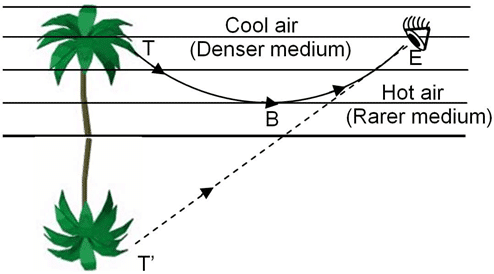
Suppose, the ray from the top of tree passes from denser to rarer layers successively and bending occurs away from normal. The rays get totally internally reflected when the angle of incidence is greater than the critical angle & a person sitting away from it sees an inverted image of the tree which produces the feeling of water on the earth’s surface. - Total reflecting prism
This is an isosceles right angled (45o – 45o – 90o) prism where a ray of light is incident perpendicular to a face, then, the refracted ray in another face makes an angle greater than critical angle and hence, TIR occurs. The ray comes out from the same face. These types of prisms are used in binocular and submarine.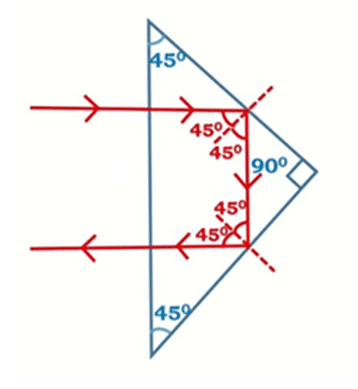
- Brilliancy of diamond
The refractive index of diamond is 2.4 and hence, its critical angle is small about 24.6o. The edges of diamond are cut such that the light falling on it undergoes multiple total internal reflection and hence makes brilliancy of diamond. - Optical fibers
Optical fiber is a flexible, transparent fiber whose central part is called core. The core is surrounded by a transparent material called cladding. The refractive index of core is greater than cladding. When a ray of light is incident at a small angle of incidence at one end, the light undergoes TIR at the core cladding boundary and it is trapped within the rod even if the rod is curved and finally comes out of the fiber at the other end without much loss of intensity.

