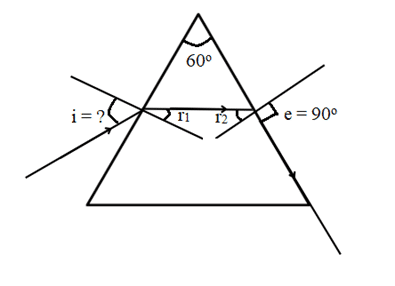
A ray of light is refracted through a prism of angle 60o. Find the angle of incidence so that the emergent ray just grazes in the second face. Refractive index of the material of the prism is 1.45. Ans: 24.2o Solutions: Angle of prism (A) = 60o Angle of incidence (i) =? For grazing emergence, (e) = 90o Refractive index of material of prism [latex](\mu)[/latex] = 1.45 We have, for second face, using Snell’s law,
Or, [latex]r_1 = 16.45^o[/latex] Again, for first face, using Snell’s law, [latex]\mu_g^a = \frac{sini}{sinr_1}[/latex]
Or, [latex]sini = 0.411[/latex]
Or, i = [latex]sin^{-1}(0.411)[/latex]
Or, i = 24.26o
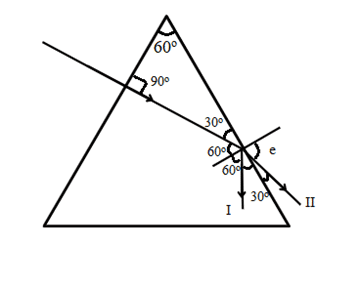
A narrow beam of light incident normally on one face of an equilateral prism. The prism is surrounded by water, what is the angle between the direction of emergent beam in two cases. [latex](\mu_w = 1.33, \mu_g = 1.45)[/latex]. Ans: 49.29o Solution: Angle of prism (A) = 60o Case I: When prism is in air [latex]\mu_g = 1.45[/latex] Let’s find the critical angle first. We know, [latex]\mu_g = \frac{1}{sinc}[/latex]
Or, c = [latex]sin^{-1}(\frac{1}{1.45}) = 43.60^o[/latex] Since, i = 60o, which is greater than critical angle (c), TIR occurs and light passes through direction (I), as shown in figure. Case II: When prism is in water. [latex]\mu_w = 1.33[/latex] & [latex]\mu_g = 1.45[/latex] Let’s find the critical angle again. We know, [latex]\mu_g^w = \frac{1}{sinc}[/latex]
Or, c = [latex]sin^{-1}(\frac{1.33}{1.45}) = 66.52^o[/latex] Since, i = 60o, which is less than critical angle (c), so, light is refracted through direction (II). Now, using Snell’s law, taking direction as reverse, [latex]\mu_g^w = \frac{sine}{sin60}[/latex]