
Basic concept of Magnetism
A magnet is a material or object that produces a magnetic field. This magnetic field is invisible but is responsible for the most notable property of a magnet: a force that pulls on other ferromagnetic materials, such as iron, and attracts or repels other magnets.
Magnetic field
A magnetic field is the magnetic effect of electric currents and magnetic materials. The magnetic field at any given point is specified by both a direction and a magnitude (or strength); as such it is a vector field. Magnetic fields can be produced by moving electric charges and the intrinsic magnetic moments of elementary particles associated with a fundamental quantum property, their spin.
Magnetic field intensity
The magnetic field intensity at a point defines as the force experienced by a unit North Pole at that point. The tangent, which is drawn on the line of forces, gives the direction of magnetic field intensity. It measures in Tesla (T) or Gauss.
Magnetic pole strength
Magnetic pole strength (symbol: p) is a physical quantity used to measure the strength of the pole of a bar magnet (or a hypothetical magnetic monopole). If there is an infinitely long wire where the electric current is I, then the magnetic pole strength is defined as follows:
Magnetic moment
The magnetic moment of a magnet is a quantity that determines the torque that experience in an external magnetic field. A loop of electric current, a bar magnet, an electron (revolving around, a molecule, all have magnetic moments.
The magnetic moment may be considered to be a vector having a magnitude and direction. The direction of the magnetic moment points from the south to North Pole of the magnet. The magnetic field produced by the magnet is proportional to its magnetic moment. More precisely, It normally refers to a system’s magnetic dipole moment, which produces the first term in the multiple expansion of a general magnetic field.
The elements of terrestrial magnetism
The elements of terrestrial magnetism are
Declination
The declination at palace is the angle between the magnetic meridian and the geographic meridian of the earth. This arises due to the earth magnetic axis not coinciding with its geographical axis. The magnetic meridian is a vertical plane at a place which passed through the axis of the freely suspended magnet. The geographic meridian is the vertical plane at a place that passes through the axis of rotation of the earth. The angle of declination varies from place to place in the earth and even at a place it shows the periodic variation also.
Dip or inclination
The angle between the direction of the total intensity of earth’s magnetic field and a horizontal line in the magnetic meridian is called angle of dip at a place. The value of dip angle at the equator is zero and at the poles is 90°. Hence value of angle of dip increases from equator to poles.
Horizontal components of earth magnetic field
The horizontal component of the earth magnetic field H is the component of the earth ‘s magnetic field along the horizontal direction in the magnetic meridian at a place.
Let I bet the magnetic field intensity at a place, H and V be its horizontal and vertical components respectively. In the magnetic meridian, the horizontal component is
H = I Cosδ
And the vertical component is V = I Sinδ
In the right-angled triangle
H2+ V2= I2cos2δ + I2sin2δ
H2+ V2= I2
Tanδ = V/H
Magnetic Permeability
Magnetic permeability of magnetic substance is defined as the ratio of magnetic induction to the magnetizing field.
Symbolically, [latex]\mu = \frac{B}{H}[/latex]. Its SI unit is [latex]Hm^{-1}[/latex].
Relative Permeability
For any material, ratio of magnetic permeability of specimen to the magnetic permeability of free space is called Relative permeability.
Symbolically, [latex]\mu_r = \frac{\mu}{\mu_o}[/latex]. It is unitless.
Magnetic Susceptibility
Magnetic susceptibility of any substance is defined as the ratio of intensity of magnetization to the magnetizing field. i.e.
[latex]\chi_m = \frac{1}{H}[/latex]. It is unitless.
Relation between [latex]\mu_r[/latex] and [latex]\chi_m[/latex]
When a magnetic material is placed in a magnetic field, it gets magnetized. Then the total magnetic induction (magnetic field) within the material is the sum of
i. intensity of externally applied magnetic field (Bo) and
ii. intensity of the field due to magnetization of material itself. (BM)
i.e., [latex]B = B_o + B_M[/latex] ……….. (i)
We know, [latex]B_o = \mu_o H;[/latex] where H is called magnetizing field intensity and [latex]B_M = \mu_o I[/latex]; where [latex]I[/latex] is called intensity of magnetization of material.
Now, the equation (i) becomes
[latex]B = \mu_o H + \mu_o I[/latex]
Or, [latex]\frac{B}{H} = \mu_o(1+\frac{I}{H})[/latex]
Or, [latex]\mu = \mu_o(1+\chi_m)[/latex]
Or, [latex]\frac{\mu}{\mu_o} = 1+\chi_m[/latex]
[latex]\therefore \mu_r = 1 + \chi_m[/latex]
Hysteresis
Magnetic hysteresis occurs when an external magnetic field is applied to a ferromagnet such as iron and atomic dipoles align themselves with it. Even when the field is removed, part of the alignment will be retained: the material has become magnetized. The lagging of intensity of magnetization [latex](I)[/latex] or magnetic induction (B) behind the magnetizing field (H) during the process of magnetization and demagnetization of a ferromagnetic material is called hysteresis.
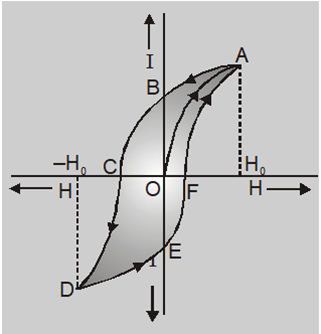
At point O, the magnetizing field (H) is zero and the intensity of magnetization (I) or B is also zero. The part OA of curve shows that I (or B) increase with H. At point A ferromagnetic material acquires the state of magnetic saturation. When H decreases, I or B also decreases along AB. At point B magnetizing field H becomes zero but I or B is non zero. The value of I or B of a material when the magnetizing field is reduced to zero is called retentivity of the material, measured by OB of curve.
Now H is increased in reverse direction to make I or B zero. I or B now decreases along BC and becomes zero at C. The value of reverse magnetizing field required to reduce residual magnetism to zero is called coercivity of the material, measured by OC of curve. When H is further increased I or B increases along CD. At D, material acquires state of magnetic saturation. (D is symmetrical to point A). Here, magnetizing field H becomes zero before I or B. The intensity of magnetization I or B always lags behind H. This is called hysteresis. The area of hysteresis loop is a measure of energy dissipated per cycle per unit volume of the specimen and depends on nature of material. The slope of I-H curve give susceptibility.
Classification of magnetic material
1. Diamagnetic,
2. Paramagnetic,
3. Ferromagnetic:
Differences between diamagnetic, paramagnetic and ferromagnetic material
| Diamagnetic | Paramagnetic | Ferromagnetic |
| The magnetic moment, intensity of magnetization and magnetic susceptibility are all negative while magnetic permeability has value less than 1. | The magnetic moment, intensity of magnetization and magnetic susceptibility are all positive while magnetic permeability has value slightly greater than 1. | The magnetic moment, intensity of magnetization and magnetic susceptibility are all positive and quite large and magnetic permeability is of the order of hundreds and thousands. |
| The magnetic susceptibility is independent of temperature. | The magnetic susceptibility decrease with rise of temperature. | The magnetic susceptibility decrease with rise of temperature. |
| They are feeble repelled by the magnet and magnetic field. | They are feeble attracted by the magnet and magnetic field. | They are strongly attracted by the magnet and magnetic field. |
| Eg. Antimony, Bismuth, Copper. | Eg. Aluminum, Chromium Magnesium. | Eg. Cobalt, Nickel, Gadolinium. |
| When the diamagnetic bar is suspended in a magnetic field it orient itself perpendicular to the applied field. | When the paramagnetic bar is suspended in a magnetic field it orient itself in the direction to the applied field. | When the ferromagnetic bar is suspended in a magnetic field it orient itself quickly direction to the applied field. |
Magnetic domains A magnetic material consists of a very large number of magnetized regions called magnetic domains.