
Optics
The study of nature and propagation of light is called optics. This branch of physics further classifies into two types: (i) Ray optics and (ii) Wave optics.
Ray optics deals with particle nature of light whereas wave optics considers light as a wave.
Ray Optics
The study of particle nature of light comes under ray optics. It works under following assumptions:
(i) Rectilinear propagation of light
(ii) Laws of reflection
(iii) Laws of refraction
Laws of Reflection:
- The incident rays, the reflected rays and the normal at the point of incidence, all the three lies in one plane.
- The angle of incidence and the angle of reflection are equal to one another.

i.e., for a normal incidence, ∠i = 0, ∠r = 0. Hence, a ray of light falling normally get back to its original path.
Spherical Mirrors:
A spherical mirror, is a part of a hollow sphere with one of its sides highly silvered.
If the outer surface of the part of the sphere is silvered and inner surface becomes reflecting, such mirror is called concave mirror. If the inner surface of the part of the sphere is silvered and outer surface becomes reflecting, such mirror is called the concave mirror.

Some Definitions
- Centre of Curvature (C): The centre of curvature of a spherical mirror is the centre of the sphere of which the mirror is a part.
- Radius of Curvature (R): The radius of curvature of a spherical mirror is the radius of the sphere of which the mirror is a part.
- Pole of the mirror (P): The centre (or the middle point) of the spherical mirror is called the pole.
- Principal axis: The line passing through the centre of curvature (C) and the pole (P) of the spherical mirror is called the principal axis.
- Focus (F): The focus of the spherical mirror is the point on the principal axis at which the incident rays parallel to the principal axis actually meet or appears to meet after reflection. For concave mirror, the incident rays parallel to the principal axis actually meet at the focus & in case of convex mirror, the incident rays parallel to the principal axis don’t actually meet but they appear to be coming from the focus after reflection.

- Focal length (f): The focal length (f) of a spherical mirror is the distance between the focus (F) and the pole (P) of the mirror. In the figure above, the distance, PF = f is the focal length.
The Concave Mirror:
Sign convention:
- All distances are measured from the pole of the mirror.
- Positive sign is used for real distances.
- Negative sign is used for virtual distances.
- For real image, magnification is positive & for virtual image, it is negative.
- The focal length & the radius of curvature are always positive.
Relation between R and f:
Let us consider, a concave mirror having focal length f and radius of curvature (R). Let, a ray of light AB parallel to the principal axis incident at B & after reflection, it passes through the focus (F). Let, C & P be the centre of curvature & the pole of the mirror.

In the figure above, ∠i = ∠ABC = angle of incidence.
∠r = ∠CBF = angle of reflection
And, from the laws of reflection,
∠i = ∠r
i.e. ∠ABC = ∠CBF …………………. (1)
But, ∠ABC = ∠BCF [∵alternate angle]
[latex]\therefore[/latex] ∠BCF = ∠CBF
So, [latex]\Delta[/latex]CBF is an isosceles triangle.
[latex]\therefore[/latex] CF = FB
If the aperture of the mirror is small, then, point B approaches to P. Then,
FB = FP
So, PC = CF + FP
= FB + FP
Or, R = f + f
[latex]\therefore[/latex] R = 2f.
Hence, the focal length of the concave mirror is a half of its radius.
Differences between real and virtual image
| Real Image | Virtual Image |
| 1. It can be projected on the screen. | 1. It cannot be projected on the screen. |
| 2. It is formed by the actual intersection of the reflected rays. | 2. It is formed by the virtual intersection of the reflected rays. |
| 3. It is inverted with respect to the object. | 3. It is erect with respect to the object. |
| 4. The image formed by human eyes, convex lens, photographic camera, etc. are the real images. | 4. The image formed by concave lens, plane mirror, etc. are the virtual images. |
Mirror Formula
Concave mirror
i. When real image is formed
Let us consider, a concave mirror of focal length f and radius of curvature R. Let, an object AB is placed in front of a concave mirror. The rays of light AM parallel to the principal axis incident at M, after reflection, passes through focus (F). Another ray AP, after reflection passes through PA‘ & finally the ray AC passes through centre of curvature and retraces its path. These rays intersect at a point A‘, where a real, inverted image A‘B‘ of the object is formed.

From figure, PC = R = radius of curvature.
PF = f = focal length
PB = u = object distance
PB‘ = v = Image distance.
[latex]\Delta[/latex]s ABC & A‘B‘C are similar triangle,
[latex]\frac{AB}{A’B’} = \frac{BC}{B’C}[/latex] ……………….. (1)
Again, [latex]\Delta[/latex]s ABP & A‘B‘P are similar triangles.
[latex]\frac{AB}{A’B’} = \frac{PB}{PB’}[/latex] ……………………… (2)
From eqn.s (1) & (2), we get,
[latex]\frac{BC}{B’C} = \frac{PB}{PB’}[/latex]
Or, [latex]\frac{PB – PC}{PC – PB’} = \frac{PB}{PB’}[/latex]
Or, [latex]\frac{u – R}{R – v} = \frac{u}{v}[/latex]
Or, uv – vR = uR – vu
Or, 2uv = uR + vR
Diving both sides by, uvR, we get,
[latex]\frac{2uv}{uvR} = \frac{uR}{uvR} + \frac{vR}{uvR}[/latex]
Or, [latex]\frac{2}{R} = \frac{1}{v} + \frac{1}{u}[/latex]
Or, [latex]\frac{2}{2f} = \frac{1}{u} + \frac{1}{v}[/latex]
Or, [latex]\frac{1}{f} = \frac{1}{u} + \frac{1}{v}[/latex]
This is the required mirror formula for concave mirror as the image formed is real.
ii. When virtual image is formed
Let, MN be the small aperture of concave mirror. An object AB is held perpendicular to the principal axis of the mirror between the focus and pole (P) as shown in figure. A virtual image (erect & magnified) of the object is formed as shown in figure. From figure,

PC = R = radius of curvature
PF = f = focal length
PA = u = object distance
PA‘ = -v = image distance
In [latex]\Delta ABC[/latex] ~ [latex]\Delta A’B’C'[/latex]
[latex]\frac{AB}{A’B’} = \frac{AC}{A’C}[/latex] …………………………………… (1)
Again, from [latex]\Delta ABP[/latex] ~ [latex]\Delta A’B’P[/latex],
[latex]\frac{AB}{A’B’} = \frac{PA}{PA’}[/latex] ………………………….. (2)
From eqns. (1) & (2), we get,
[latex]\frac{AC}{A’C} = \frac{PA}{PA’}[/latex]
Or, [latex]\frac{PC – AP}{PC + PA’} = \frac{PA}{PA’}[/latex]
Or, [latex]\frac{R – u}{R – v} = \frac{u}{-v}[/latex]
Or, -vR + uv = uR – uv
Or, vR + uR = 2uv
Dividing both sides by uvR, we get,
[latex]\frac{2uv}{uvR} = \frac{uR}{uvR} + \frac{vR}{uvR}[/latex]
Or, [latex]\frac{2}{R} = \frac{1}{v} + \frac{1}{u}[/latex]
Or, [latex]\frac{2}{2f} = \frac{1}{u} + \frac{1}{v}[/latex]
Or, [latex]\frac{1}{f} = \frac{1}{u} + \frac{1}{v}[/latex]
This is the required mirror formula for concave mirror as the image formed is virtual.
Image formed by a concave mirror
a. When the object is at infinity
Image is formed at focus when the object is at infinity. i.e. if u = ∞,
[latex]\frac{1}{f} = \frac{1}{u} + \frac{1}{v}[/latex]
[latex]\therefore \frac{1}{f} = \frac{1}{\infty} + \frac{1}{v}[/latex]
Or, v = f
Nature of Image
- Real
- Highly diminished.
b. When the object is beyond C
Image is formed between focus (F) and centre of curvature (C), when the object is placed beyond C.

Nature of image
- Real
- Diminished
- Inverted
c. When the object is at C
Image is formed at the centre of curvature (C) when the object is placed at centre of curvature (C). i.e., when u = R = 2f, then,

[latex]\frac{1}{f} = \frac{1}{u} + \frac{1}{v}[/latex]
[latex]\frac{1}{f} = \frac{1}{2f} + \frac{1}{v}[/latex]
Or, [latex]\frac{1}{v} = \frac{1}{f} – \frac{1}{2f}[/latex]
Or, v = 2f = R
Nature of Image
- Real
- Inverted
- Same size of the object.
d. Object between F and C
The image is formed beyond centre of curvature (C) when the object is placed between focus (F) and centre of curvature (C).

Nature of Image
- Real
- Inverted
- Magnified
e. Object at F
The image is formed at infinity when the object is placed at focus (F).
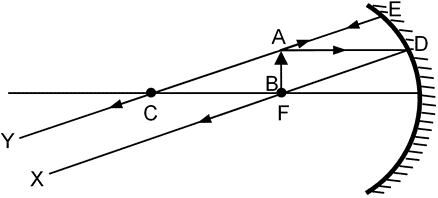
Nature of Image
- Real
- Inverted
- Highly magnified
We have, u = f, then,
[latex]\frac{1}{f} = \frac{1}{u} + \frac{1}{v}[/latex]
[latex]\therefore \frac{1}{f} = \frac{1}{f} + \frac{1}{v}[/latex]
Or, [latex]\frac{1}{v} = 0 [/latex]
Or, v = ∞
f. Object between F & P
The image is formed on the other side of the mirror, when the object is placed between focus (F) and pole (P). In the ray diagram, we can see that, the reflected rays do not meet at a point but it seems to appear from the opposite side of the mirror. So,

Nature of Image
- Virtual
- Erect
- Magnified.
Convex Mirror
Sign Conventions
- All distances are measured from the pole of the mirror.
- Positive sign is used for real distances.
- Negative sign is used for virtual distances.
- Magnification is always taken as negative.
- The focal length & the radius of curvature are always taken as negative.
Relation between R and f
Let us consider, a ray of light AB parallel to the principal axis is incident at B on convex lens of focal length f and radius of curvature R. After reflection, it passes through BD and it appears to be coming from the focus F.

Here, ∠i = ∠ABN = angle of incidence.
∠r = ∠DBN = angle of reflection.
Now, ∠CBF = ∠DBN = ∠r (VOA).
And, ∠ABN = ∠BCF = ∠i (Corresponding angle).
∵ ∠i = ∠r
So, CF = BF. Now, if the aperture of the mirror is small, then, B and P are very close. So, FP = FB = CF. Thus,
CP = CF + FP = PF + PF
[latex]\therefore[/latex] R = f + f.
[latex]\therefore[/latex] R = 2f.
Or, f = [latex]\frac{R}{2}[/latex]
i.e., focal length of convex mirror is half of the radius of curvature.
Mirror formula for convex mirror
Let, MN be the small aperture of mirror. A ray of light from an object AG parallel to principal axis incident at point G and reflected along GQ. Another ray of light AP is reflected along PD. Third ray AE is reflected back. When these rays are produced back, they are intersecting at a point A’, where, a virtual, erect and diminished image (A’B’) is formed.

From figure, PB = u = object distance.
PC = R = radius of curvature.
PB = -v = image distance for virtual image.
PF = f = focal length.
In [latex]\Delta ABC[/latex] ~ [latex]\Delta A’B’C[/latex],
[latex]\frac{AB}{A’B’} = \frac{BC}{B’C}[/latex] ………………… (i)
Again, in [latex]\Delta ABP[/latex] ~ [latex]\Delta A’B’P[/latex]
[latex]\frac{AB}{A’B’} = \frac{PB}{PB’}[/latex] ……………….. (ii)
From eqn. (i) and (ii), we get,
[latex]\frac{BC}{B’C} = \frac{PB}{PB’}[/latex]
Or, [latex]\frac{PC+PB}{PC – PB’} = \frac{PB}{PB’}[/latex] [∵ PB’ = -v, for virtual image]
Or, [latex]\frac{-R + u}{-R+v} = \frac{u}{-v}[/latex]
Or, vR – uv = -uR + uv
Or, vR + uR = 2uv
Dividing both sides by uvR, we get,
Or, [latex]\frac{vR}{uvR} + \frac{uR}{uvR} = \frac{2uv}{uvR}[/latex]
Or, [latex]\frac{1}{u} + \frac{1}{v} = \frac{2}{R}[/latex]
[latex]\frac{1}{u} + \frac{1}{v} = \frac{2}{2f}[/latex]
[latex]\therefore \frac{1}{u} + \frac{1}{v} = \frac{1}{f}[/latex].
This is the required mirror formula for convex mirror as the image formed is virtual.
Linear Magnification
It is defined as the ratio of size of the image obtained by mirror to the size of the object. It is denoted by m.
[latex]\therefore m = \frac{size\ of\ image\ (I)}{size\ of\ object\ (O)}[/latex]
It can also be defined as the ratio of image distance to the object distance.
Linear magnification (m) = [latex]\frac{v}{u}[/latex]
Magnification is positive for real image and negative for virtual image.
Application of spherical mirror
a. Concave Mirror
- Reflecting telescope.
- Dental mirror.
- Make-up and shaving mirror.
b. Convex mirror
- Driving mirror as rear view of vehicles.
- Safe view at dangerous corners.