
Wave:
The continuous transfer of disturbance from one part of a medium to another through the successive vibrations of the medium in the mean position is called wave. Through the motion, the energy and momentum are carried out from one region to another. It is called the oscillations instead of wave if the energy is not transferred.
Some important terms:

Crest:
Crest is the point of maximum displacement of the particles of a medium above the equilibrium (mean) position.
Trough:
Trough is the point of maximum displacement of the particles of a medium below the equilibrium (mean) position.
Amplitude:
When a mechanical wave passes through the medium, the maximum displacement produced by the wave from its equilibrium position is called its amplitude.
Wavelength:
The distance covered by the wave over one complete cycle when it is travelled over any time is called wavelength. It is denoted by l. In another way, it is also defined as the distance between two successive crest and trough.
Frequency:
The number of oscillations made by the particle in one second is called its frequency. It is denoted by f.
Period:
The time taken by vibrating particle to complete one oscillation is called its period. It is denoted by T. It is simply reciprocal of frequency. i.e.
T = [latex]\frac{1}{f}[/latex]
Wave velocity:
The distance travelled by wave per second is called wave-velocity (v). i.e.
v = [latex]\frac{distance\ travelled\ by\ wave}{time\ taken}[/latex]
At time T, wave travels ‘[latex]\lambda[/latex]’ distance, so, v = [latex]\frac{\lambda}{T}[/latex]
= [latex]\lambda \times \frac{1}{T} = \lambda \times f[/latex]
∴ v = [latex]\lambda f[/latex]
Phase:
The state of motion of a particle at a given place and time is called its phase. That is, where is particle? And what is the direction of the wave in that time? It is measured in terms of angle, called ‘phase angle’.
Types of waves:
Transverse wave:
A wave in which the particles of the medium vibrate up and down at right angles to the direction in which wave is moving is called transverse wave. A transverse wave consists of crest and trough. Example, water waves formed on the surface of water, waves produced in a string when its end is jerked and light waves, sound waves.

Longitudinal wave:
The waves in which the particles of the medium vibrate parallel to the direction of the wave in which it is moving is called a longitudinal wave. It consists of compressions and rarefactions. Example sound waves and waves in a spring.

Differences between mechanical wave and electromagnetic wave:
| Mechanical wave | Electromagnetic wave |
| 1. It needs a material medium for its propagation. | 1. It does not need a material medium for its propagation. |
| 2. Speed is less than electromagnetic wave. Example sound waves. | 2. Speed is more than mechanical wave. Example light-wave, X-rays. |
Differences between transverse wave motion and longitudinal wave motion:
| Transverse wave motion | Longitudinal wave motion |
| 1. The particles of medium vibrate perpendicularly to the direction of propagation of wave. | 1. The particles of the medium vibrate to the direction of the propagation of the wave. |
| 2. It consists of crest and trough. Example: Wave in string, water surface wave, etc. | 2. It consists of compressions and rarefactions. Example sound waves, waves in spring, etc. |
Path differences:
In a wave, the positions or stages of vibrations of particles can be expressed in terms of distances from the origin or some reference point. If the position of two particles is given in terms of the distance between the particle, then, it is called as path difference.
Relation between phase difference and path difference:
Consider, a wave having wavelength l and frequency f is travelling with velocity v as shown in the figure.

A point A is at a distance x from the particle at the origin O, then, the path difference between A and O is x, for the path difference of l, the phase difference is 2π. For the path difference of X, the phase difference is [latex][\frac{2\pi}{\lambda}.x][/latex].
Therefore, phase difference, [latex]\Delta \phi = \frac{2\pi}{\lambda}.\Delta x[/latex]
Progressive wave:
The wave that travels from one region of medium to another is called the progressive wave. In other way, the wave in which, the wave profile travels in forward direction with constant amplitude and frequency is called progressive wave. The wave profiles move with a speed of the wave.
Derivation of progressive wave equation:
Consider a progressive wave moving with velocity v along the positive x direction as indicated in figure.

All the particles in the medium oscillates with time period T and amplitude a. Suppose, a particle O, at x = 0 starts moving along positive x direction. The displacement of the particle at x = 0 at any instant of time t is given by the equation:
y = aSinωt
where, ω is the angular velocity of the particle = [latex]\frac2\pi{}{T}[/latex].
Again, suppose, second particle P is at a distance x from O and their phase difference is , then,
[latex]\phi = \frac{2\pi}{\lambda}x[/latex]
Since, the disturbance reaches in later time to the particles to right of O and hence, the phase lag goes on increasing in this direction. Hence, displacement of a particle at P is:
y = displacement of particle at O with phase difference of ([latex]-\phi[/latex])
= [latex]asin(\omega t – \phi) = asin(\omega t – \frac{2\pi}{\lambda}x)[/latex]
= aSin(ωt-kx) …………… (i)
Where, k = [latex]\frac{2\pi}{\lambda}[/latex], is propagation constant or wave number.
Also,
[latex]y = asin(\frac{2\pi}{T}t – \frac{2\pi}{\lambda}x)[/latex]
Or, [latex]y = asin2\pi(\frac{t}{T}-\frac{x}{\lambda})[/latex] ……………………… (ii)
Again, from eqn. (i),
[latex]y = asin(2\pi ft-\frac{2\pi}{\lambda}x)[/latex]
Or, [latex]y=asin(\frac{2\pi}{\lambda}vt – \frac{2\pi}{\lambda}x)[/latex] [latex][∵ f = \frac{v}{\lambda}][/latex]
Or, [latex]y = asin\frac{2\pi}{\lambda}(vt – x)[/latex] ……………….. (iii)
This is the required equation (i) and (ii) of progressive wave when the wave travels from left to right. (positive x-axis)
If the wave travels from right to left (negative x-axis), the equation of progressive wave becomes,
y(x,t) = ASin(ωt+kx)
Principle of Superposition:
When two or more waves travels simultaneously in a medium, they move independently without affecting the motion of one another. The resulting displacement of a particle at any instant of time is obtained by the vector sum of individual displacement of the superposing waves and this is called principle of superposition.

If y1, y2, y3,…………,yn are the displacement of n superposing waves at a point in a medium then, the resultant displacement at that point is given by:
[latex]\vec{y} = \vec{y_1}+\vec{y_2}+\vec{y_3}+…………….+\vec{y_n}[/latex].
Stationary wave:
When two progressive waves having same frequency and amplitude but moving in opposite direction superimposed upon each other, they give rise to a new type of wave called stationary wave. Since there is no flow of energy along the way as in case of progressive wave, so, stationary waves are also called standing waves.
Characteristics:
They may be transverse or longitudinal in nature. In a stationary wave, there are certain points where the amplitude of vibration is maximum. Such points are called anti nodes. In mid -way between the antinodes, there are some points, where the amplitude of vibration is zero, such points are called nodes.

Differences between progressive wave and stationary wave:
| Progressive wave | Stationary wave |
| 1. The amplitude of oscillation is same at all position in medium. | 1. The amplitude of oscillation are different at different place in medium. |
| 2. No particle is permanently at rest. | 2. The particles at nodes are permanently at rest. |
| 3. The particles of the medium pass through their mean position one by one. | 3. All particles of the medium pass simultaneously through their mean position. |
| 4. Pressure vibration takes place at every point. | 4. Pressure variation are maximum at nodes and nodes and antinodes. |
| 5. There exists a regular phase difference between successive particles. | 5. All the particles in between two successive nodes are in phase. |
Equation of stationary wave:
Consider two progressive waves of the same amplitude and frequency are travelling with same speed in opposite direction. The equation of the wave travelling from left to right from positive x-direction is:
y1 = aSin(ωt-kx) …………… (i)
Again, the equation of the wave travelling from right to left is:
y2 = aSin(ωt+kx)………….(ii)
where, a = amplitude of vibration.
ω = 2πf = angular velocity of the wave.
When these two waves superimpose upon each other, they form a stationary wave. According to principle of superposition, the resultant displacement at any point is:
y = y1 + y2
= aSin(ωt-kx) + aSin(ωt+kx)
= a[Sin(ωt-kx) + Sin(ωt+kx)]
= a.2Sinωt.Coskx = (2aCoskx). Sinωt
∴ y = ASinωt ………… (iii)
Where, A = 2aCoskx = amplitude of stationary wave, which depends on the distance x.
The amplitude will be maximum when ‘A’ becomes maximum.
When, Coskx = ±1
Or, kx = 0, π, 2π, 3π
Or, [latex]\frac{2\pi}{\lambda}x=n\pi[/latex] (n = 0, 1, 2, …………)
Or, x = [latex]\frac{n\lambda}{2}[/latex]
Hence, the amplitude becomes maximum i.e. antinodes are occurred at x = [latex]0, \frac{\lambda}{2}, \lambda , \frac{3\lambda}{2},[/latex] ………..
This means if one antinode is at x = 0, the next antinode will be at a distance of [latex]\frac{\lambda}{2}[/latex] and second antinode will be at a distance of [latex]\lambda[/latex] and so on.
The distance between any two consecutive antinode is: [latex]\frac{\lambda}{2}[/latex]
The amplitude will be minimum when:
Coskx = 0
Or, kx = [latex]\frac{\pi}{2},\frac{3\pi}{2},\frac{5\pi}{2},…………[/latex]
Or, [latex]\frac{2\pi}{\lambda}x[/latex] = (2n+1)[latex]\frac{\pi}{2}[/latex] (n = 0, 1, 2, ………….)
∴ x = (2n+1) [latex]\frac{\lambda}{4}[/latex]
Hence, amplitude becomes minimum, i.e. nodes occurred at:
x = [latex]\frac{\lambda}{4}, \frac{3\lambda}{4}, \frac{5\lambda}{4}[/latex]
The distance between any two consecutive node is:
[latex]\frac{3\lambda}{4}-\frac{\lambda}{4}=\frac{\lambda}{2}[/latex]
Wave Properties
- Reflection
When the waves are incident on a boundary, a part of incident energy returns back into the same medium and this phenomenon is called reflection of waves.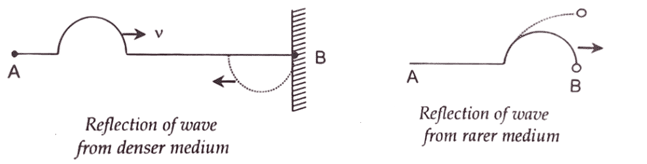

- Reflection from denser medium
Let, a string AB, in which a crest formed on it is incident on a rigid support at B. It exerts a force at point B. And, according to Newton’s 3rd law of motion, the wall also exerts same force. As a result, the crest gets reflected back in the form of trough. So, the phase difference of takes place when a transverse wave is reflected from a denser medium. - Reflection from rarer medium
Let, a string AB, whose both ends are free. A crest is travelling from left to right. When crest reaches at B, B moves in upward direction and pulls the point located left of it in upward direction. As a result, crest is returned in the form of crest. So, the phase difference of zero takes place when a transverse wave is reflected from a rarer medium. - Echo and Reverberation
The repetition of sound due to reflection from a distant surface is called echo. If d be the distance between reflector and source, then,
Time interval (t) = [latex]\frac{2d}{v}[/latex]
Since, persistence of our hearing is 0.1 sec, so, d = [latex]\frac{v.t}{2} = \frac{350\times 0.1}{2}[/latex] = 17.5 m (vel. of sound at 30oC = 350 m/s approx.)
i.e. minimum distance between source and reflector to hear echo is 17.5 m
But, when the distance between source and reflector is less than 17.5 m, the original sound is prolonged, which is called reverberation.
- Refraction
The phenomena of bending of sound waves when it travels from one medium to another is called refraction of sound. Sounds are easier to listen during nights than day time. It is because the temperature of air adjacent to the ground may be cooler and have less velocity, which acts as denser medium than higher level having more velocity, which acts as rarer medium. As a result, refraction occurs and sound travels at larger distances and easier to listen. - Diffraction
The phenomena of spreading of wave around the edge of an obstacle or aperture when it passes through it is called diffraction of sound. For the diffraction to occur, size of obstacle must be comparable to the wavelength of wave. The sound is heard inside the room even the source is outside is an example of diffraction. - Interference
When two waves of same frequency and in same phase travel in the same direction, they superpose such that the intensity of resultant wave is maximum at certain point and minimum at another points. This phenomenon is called interference of wave.
Finished studying this chapter resource?
Mark this chapter as complete to update your course progress.