
3.1 FLUID STATICS
THEORETICAL QUESTIONS
Old Course
SHORT ANSWER QUESTION
- [2075 ‘GIE’] Why do clouds seem to be floating in the sky?
- [2075 ‘B’] Which one gives the feeling of heaviness in the case of a kilogram of cotton or a kilogram of lead? Why?
- [2074 ‘S’] A body floats in a liquid contained in a beaker. The whole system falls under gravity. What is the value of upthrust on the body due to liquid?
- [2074 ‘A’] Why is the bottom of a ship made heavy? Explain.
NUMERICAL PROBLEMS
- [2074 ‘B’] An iceberg having a volume of 2060 cc floats in sea water of density 1030 kgm-3 with a portion of 224 cc above the surface. Calculate the density of ice. Ans: 918 kgm-3
- [2073 ‘S’]A boy can lift a maximum load of 150 N of water. How many litres of mercury of density 13600 kgm-3 he can lift in an identical vessel? Ans: 1.1 liter
- A geologist finds that a moon rock whose mass is 7.2 kg has an apparent mass 5.88 kg when submerged in water. What is the density of the rock? Ans: 5454.54 [latex]kgm^{-3}[/latex]
- A string supports a supports a solid iron object of mass 200 gm totally immerged in a liquid of specific gravity 0.9. Calculate the tension in the string if the density of iron is 8000 [latex]kgm^{-3}[/latex]. Ans: 1.775 N
- An alloy of mass 588 g and volume 1000 c.c. is made of iron of density 8.0 gm/cc and aluminium of density 2.7 gm/cc. Calculate the proportion by (i) volume (ii) by mass of the constituents of the alloy. Ans: (i) [latex]6\times 10^{-5}\ m^3, 4\times 10^{-5}\ m^3[/latex] (ii) 0.48 kg, 0.108 kg
- A string supports a solid iron object of mass 200 gm totally immersed in a liquid of density 800 [latex]kgm^{-3}[/latex]. The density of iron is 8000 [latex]kgm^{-3}[/latex]. Calculate the tension in the string. Ans: 1.8 N
- A string supports a solid iron of mass 200 gm totally immersed in a liquid of density 900 [latex]kgm^{-3}[/latex]. Calculate the tension in the string if the density of iron is [latex]8000\ kgm^{-3}[/latex]. Ans: 1.775 N
- An iceberg having a volume of 2060 cc floats in sea-water of density 1030 [latex]kgm^{-3}[/latex] with a portion of 224 cc above the surface. Calculate the density of ice. Ans: 918 kg/m3
- A piece of gold-aluminium alloy weights 100 cc in air and 80 g in water. What is the weight of the gold in the alloy if the relative density of gold is 19.3 and that of aluminium is 2.5? Ans: 0.057 kg
- A string supports a solid iron object of mass 180g totally immersed in a liquid of density 800 kg/m3. The density of iron is 8000 kg/m3. Calculate the tension in the string. Ans: 1.62 N
- A 25 cm thick block of ice floating on fresh water can support an 80 kg man standing on it, what is the smallest area of the ice block? (sp. gr. of ice = 0.917). Ans: 4 m2
- A density of ice is 971 [latex]kgm^{-3}[/latex], and the approximate density of seawater in which an iceberg float is 1025 [latex]kgm^{-3}[/latex]. What fraction of the iceberg, is beneath the water surface? Ans: 0.95
3.2 SURFACE TENSION
MCQS
- [2081 GIE ‘B’] A liquid neither rise nor fall in a capillary tube. The angle of contact is
a. 0o
b. Less than 90o
c. 90o
d. Greater than 90o - [2081 B/C] Two capillary tubes P and Q of radii 4mm and 2mm are dipped in water. What is the ratio of heights through which liquid rises in the tubes P and Q
a. 1:2
b. 2:1
c. 1:4
d. 4:1 - [2080 GIE ‘B’] Two capillary tubes X and Y having radii 0.4 cm and 0.8 cm are dipped into the same liquid. What will be the ratio of heights through which the liquid rises in the tubes X and Y?
a. 1:2
b. 2:1
c. 1:4
d. 4:1 - [2080 ‘P’] Two capillary tubes A and B of radii 2 mm and 4 mm are dipped in the same liquid. What is the ratio of heights through which liquid rises in the tubes A and B?
a. 1:2
b. 2:1
c. 1:4
d. 4:1 - [2079 GIE ‘A’] If a liquid does not wet the solid surface, the angle of contact is
a. Less than 90o
b. 90o
c. greater than 90o
d. 0o - [2079 GIE ‘B’] The SI unit of surface tension is
a. dyne/cm
b. N/m
c. N/m2
d. Nm - [2079 ‘O’] A liquid does not wet the surface of a solid if the angle of contact is,
a. 90o
b. less than 90o
c. greater than 90o
d. 0o
Answers
| 1.c | 2.a | 3.b | 4.b | 5.c | 6.b | 7.c |
THEORETICAL QUESTIONS
New Course
- [2081 ‘B/C’] Derive a relation between surface tension and surface energy.[2]
- [2081 ‘D’] Define capillarity with two suitable examples. [2]
- [2079 GIE ‘B’]
- Define surface tension. [1]
- Establish a relation between surface tension and surface energy of a liquid. [2]
- [2079 ‘O’] Define surface tension.
Old Course
SHORT ANSWER QUESTION
- [2076 ‘B’] Why does hot soup taste better than cold soup?
- [2076 ‘C’] A tiny liquid drop is spherical but larger drop has oval shape. Why?
- [2075 ‘A’] Why is soup solution a better clearing agent than ordinary water?
- [2075 ‘B’] How long does shape of the surface of mercury look like in a capillary tube dipped in it? Explain in a figure with proper justification.
- [2074 ‘A’] Explain why liquid drops are spherical in shape?
- [2074 ‘B’] Why are liquid drops spherical in shape? Explain.
- [2073 ‘S’] It is observed that the surface of a liquid in a capillary tube dipped in it either convex or concave. What may be the reason? Explain.
- [2073 ‘D’] Hot soup gives better taste than cold one, why?
- [2072 ‘S’] On what factors does the surface tension of a liquid depend? Explain.
- [2072 ‘C’] Why the small liquid drops are spherical while large drops are flat?
LONG ANSWER QUESTIONS
- [2076 ‘A’ ‘GIE’] What causes liquid fall or rise in a capillary tube? Show that h = [latex]\frac{2TCos\theta}{\rho rg}[/latex], where the symbols have their usual meanings.
- [2076 ‘B’ ‘GIE’] What is capillarity? Deduce an expressive for the rise of a liquid in a capillary tube.
- [2073 ‘C’] What is capillarity? Deduce a relation for the height of liquid column rise in a capillary tube when one end is dipped in the liquid.
- [2072 ‘D’] Define surface tension and angle of contact. Deduce an expression for rise of a liquid in a capillarity tube.
NUMERICAL PROBLEMS
New Course
- [2079 GIE ‘B’] Find the workdone required to break up a drop of water of radius [latex]5\times 10^{-3} m[/latex] into eight drops of water assuming isothermal condition. (Surface tension of water = [latex]7.2\times 10^{-2} N/m)[/latex] [2] Ans: [latex]2.26\times 10^{-5}[/latex]
Old Course
- [2074 ‘S’] Angle of contact of mercury with glass is 135o. A narrow tube of glass having diameter 2 mm is dipped in a beaker containing mercury. By what height does the mercury go down in the tube relative to the level of mercury outside? (Surface Tension of mercury = 540 dyne/cm) Ans: – 5.6 mm
- [2072 ‘E’] A capillary tube of 0.4 mm diameter is placed vertically inside a liquid of density 800 kgm-3, surface tension [latex]5\times 10^{-2}Nm^{-1}[/latex] and angle of contact 30o. Calculate the height to which liquid rises in the capillary tube. Ans: 0.055 m
3.3 VISCOSITY
MCQS
- [2082] Two spherical rain drops of equal size are falling vertically downwards with terminal velocity of 0.15 m/s. What would be the terminal velocity if these drops were combined to form a larger drop?
a. 0.15 m/s
b. 0.24 m/s
c. 0.31 m/s
d. 0.48 m/s - [2081 GIE ‘A’] Two hail stones with radii in the ratio of 1:2 fall from a great height through the atmosphere. What will be ratio of their terminal velocities
a. 1:2
b. 2:1
c. 1:4
d. 4:1 - [2081 D] If the meniscus of a liquid kept in a glass tube is plane then what will be the value of angle of contact?
a. zero
b. less than 90o
c. greater than 90o
d. equal to 90o - [2080 GIE ‘A’] A spherical ball is dropped into a long column of a viscous liquid. The speed (v) of the ball as a function of time (t) may be best represented by
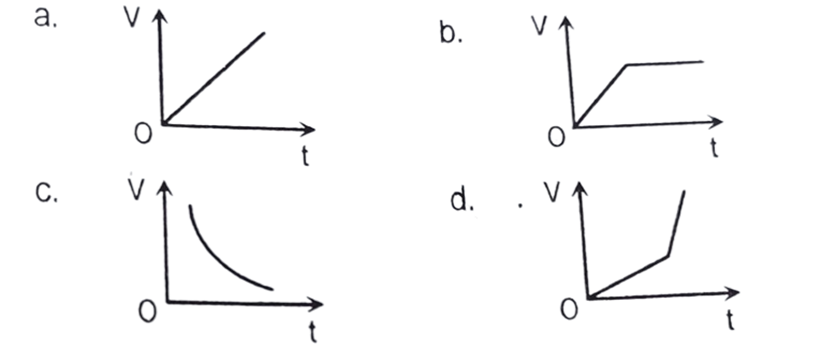
- [2080 ‘R’]Bernoulli’s Principle is based on the law of conservation of
a. mass
b. energy
c. linear momentum
d. angular momentum - [2079 ‘V’] Water is flowing at 12 m/s in a horizontal pipe. If the pipe widens to twice its original diameter, the flow speed in the wider section is
a. 6 m/s
b. 9 m/s
c. 2 m/s
d. 3 m/s
Answers
| 1.b | 2.c | 3.d | 4.b | 5.b | 6.d |
THEORETICAL QUESTIONS
New Course
- [2082] Define laminar flow and turbulent flow of liquid. [2]
- [2081 GIE ‘A’]
- Define coefficient of viscosity. Write its SI unit and dimension. [2]
- A spherical solid of density falls through a long column of liquid of density and coefficient of viscosity and soon attains terminal velocity v.
- Draw a free body diagram for the solid and write the components of forces acting on it. [1]
- Write an expression for terminal velocity of the solid. [1]
- If the radius of the spherical solid is doubled, how does terminal velocity changes? [1]
- [2081 GIE ‘B’]
- State Bernoulli’s principle. [1]
- Under what condition does the Bernoulli’s equation hold strictly? [2]
- [2080 GIE ‘B’]
- Define coefficient of viscosity. [1]
- Derive a relation for terminal velocity of a spherical body falling through a viscous liquid using Stoke’s law. [3]
- During certain windstorm, light roofs are blown off, why? [1]
- [2080 ‘P’]
In an experiment, a spherical ball of radius ‘r’ and density ‘[latex]\rho[/latex]’ falls freely through the glycerin of density as shown in figure.

- Write the components of forces acting on the body by drawing free body diagram. [1]
- b. Sketch a graph by showing the nature of variation of velocity of ball with time. [1]
- If the drop soon attains constant downward velocity, then find its expression. [3]
- [2080 ‘R’] According to Stoke’s law, when a ball of radius r is falling in a viscous fluid, the viscous force produced is equal to where symbols have their usual meanings.
- Define coefficient of viscosity. [1]
- How can you use this method to determine the coefficient of viscosity of a liquid? Explain. [2]
- [2079 GIE ‘A’]
- State Bernoulli’s principle. [1]
- Derive Bernoulli’s equation. [3]
- A man standing on the platform near the railway line be sucked in by a fast-moving train, why? [1]
- [2079 ‘O’] State Bernoulli’s theorem. [1]
- [2079 ‘V’]
- State Stoke’s Law. [1]
- Describe a method to determine terminal velocity of a spherical body falling through a viscous liquid using Stoke’s law. [2]
Old Course
SHORT ANSWER QUESTION
- [2076 ‘B’ ‘GIE’] An airplane requires a long run on the ground before taking off. Explain.
- [2073 ‘C’] Small air bubbles rise slowing while big bubbles rise rapidly through the liquid. Why?
- [2072 ‘D’] Why is a suction effect experienced by a person standing close to the platform at a section when a fast train passes?
- [2072 ‘E’] Explain with a diagram, the meaning of velocity gradient in the case of liquid flowing in a tube.
LONG ANSWER QUESTION
- [2076 ‘C’] What is terminal velocity? Derive an expression for the terminal velocity of a small spherical body falling through a viscous fluid.
- [2074 ‘S’] Using dimensional consideration, deduce Poiseuille’s formula for the rate of flow of a liquid through a tube.
- [2074 ‘A’] Describe Stoke’s method to find the coefficient of viscosity of liquid in the laboratory with necessary theory.
- [2074 ‘B’] State and prove Bernoulli’s principle.
- [2072 ‘S’] What is terminal velocity? Describe Stoke’s method to determine the coefficient of viscosity of a liquid.
- [2072 ‘C’] State and prove Bernoulli’s theorem for the steady flow of an incompressible and non-viscous flow.
- [2072 ‘E’] State and prove Bernoulli’s theorem in flowing liquid.
NUMERICAL PROBLEMS
New Course
- [2082] Water flows steadily through a horizontal pipe of non-uniform cross section. If the pressure of water is [latex]4\times 10^4 Nm^{-2}[/latex] at a point where the velocity of flow is 2 m/s and cross section is 200 cm2. Calculate the pressure at a point where cross section reduces to 50 cm2. (density of water = 1000 kg/m3). [3] Ans: [latex]1\times 10^4 N/m^2[/latex]
- [2081 GIE ‘B’] Caster oil at 20oC has a coefficient of viscosity 2.42 [latex]NSm^{-2}[/latex] and density 940 [latex]kgm^{-3}[/latex]. Calculate the terminal velocity of a steel ball of radius 1 mm falling under gravity in the oil, taking the density of steel as 7800 [latex]kgm^{-3}[/latex]. (Take g = [latex]10 ms^{-2}[/latex]). [2] Ans: [latex]6.3\times 10^{-3}[/latex] m/s
- [2081 ‘B/C’] N identical spherical drops of water falling with a terminal velocity [latex]v_1[/latex] were to coalesce to form a bigger drop and fall with a new terminal velocity [latex]v_2[/latex] through air. (Neglect air resistance)
i. Obtain a relation between [latex]v_2[/latex] and [latex]v_1[/latex]. [2]
ii. If N = 2 and [latex]v_1[/latex] = 0.4 then calculate [latex]v_2[/latex]. [1] Ans: 0.64 m/sec. - [2081 ‘D’] Water flows steadily through a horizontal pipe of non-uniform cross-section. If the pressure of water is [latex]4\times 10^4 Nm^{-2}[/latex] at a point where the velocity of the flow is [latex]2 ms^{-1}[/latex] and cross-section is 0.02 m2. What is the pressure at a point where cross-section reduced to 0.01 m2? [3] Ans: [latex]3.4\times 10^4 Nm^{-2}[/latex]
- [2080 GIE ‘A’] An air bubble of radius 1 cm is rising at a steady rate of 5 mm/s through a liquid of density 0.8 g/cm3. Calculate the coefficient of viscosity of the liquid. (Neglect the density of air) [3] Ans: 35.56 [latex]Nsm^{-2}[/latex]
- [2080 ‘R’] A horizontal pipe of 25 cm2 cross section carries water at a velocity of 3 m/s. The pipe feeds into a smaller pipe with a cross section of 15 cm2. Determine the pressure change that occurs on going from the larger diameter pipe to the smaller pipe. [2] Ans: 8000 Pa
- [2079 ‘O’/2075 ‘S’/2072 ‘D’] Caster oil at 20oC has a coefficient of viscosity 2.42 [latex]Nsm^{-2}[/latex] and density 940 [latex]kgm^{-3}[/latex]. Calculate the terminal velocity of a steel ball of radius 2mm falling under the gravity in the oil, taking the density of steel as 7800 [latex]kg/m^3[/latex]. (g = 10 m/s2) [3] Ans: 0.025 [latex]ms^{-1}[/latex]
- [2079 ‘V’] Two spherical rain drops of equal size are falling through air with terminal velocity 10 cm/s. If these two drops were to coalesce to form a single drop, what would be the new terminal velocity? Ans: 15.87 cm/sec
Old Course
- [2076 ‘B’] Eight spherical rain drops of the same mass and radius are falling down with a terminal speed of 5 [latex]cms^{-1}[/latex]. If they coalesce to form one big drop, what will be its terminal speed? Ans: 0.2 m/s
- [2075 ‘A’] Calculate mass of an aeroplane with the wings of area 55 m2 flying horizontally. The velocity of air above the below the wings is 155 m/s and 140 m/s respectively. Ans: [latex]1.57\times 10^4 kg[/latex]
- [2073 ‘S’] Calculate the magnitude and direction of the terminal velocity of an air bubble of radius 1mm passing through an oil of viscosity 0.2 [latex]Nsm^{-2}[/latex] and specific gravity 0.9 if the density of air is 1.29 [latex]kgm^{-3}[/latex]. Ans: 0.0099 [latex]ms^{-1}[/latex] unwards
- [2073 ‘D’] Eight spherical raindrops of equal size are falling vertically through air with a terminal velocity of 0.15 m/s. What would be the terminal velocity, if they coalesce to form a big drop? Ans: 0.6 m/s
Finished studying this chapter resource?
Mark this chapter as complete to update your course progress.