
- [latex]\vec{A}[/latex] and [latex]\vec{B}[/latex] are two non-zero vectors. If |[latex]\vec{A}\times \vec{B}[/latex]| = [latex]\vec{A}.\vec{B}[/latex], what is the angle between [latex]\vec{A}[/latex] and [latex]\vec{B}[/latex] ?
OR, If the scalar product of two vectors in equal magnitude of their product, find the angle between them.
Solution:
Let [latex]\theta[/latex] be the angle between [latex]\vec{A}[/latex] and [latex]\vec{B}[/latex]. The scalar product of [latex]\vec{A}[/latex] and [latex]\vec{B}[/latex] is given by
[latex]\vec{A}.\vec{B}=ABCos\theta[/latex] ……………………… (i)
The magnitude of the vector product of and is given by,
|[latex]\vec{A}\times \vec{B}[/latex]| = ABsin[latex]\theta[/latex] ……………….. (ii)
According to the question, we have,
[latex]\vec{A}.\vec{B}=|\vec{A}\times \vec{B}|[/latex]
Or, ABcos[latex]\theta = ABSin\theta[/latex]
Or, [latex]tan\theta = 1[/latex]
[latex]∴ \theta = 45^o[/latex]
Hence, required angle is 45o.
- If [latex]\vec{A}.\vec{B}=0,[/latex] what is the value of angle between [latex]\vec{A}[/latex] and [latex]\vec{B}[/latex]?
Solution:
[latex]\vec{A}.\vec{B}=|\vec{A}||\vec{B}|Cos\theta = AB Cos\theta[/latex], where [latex]\theta[/latex] be the angle between [latex]\vec{A}[/latex] and [latex]\vec{B}[/latex].
When two vectors [latex]\vec{A}[/latex] & [latex]\vec{B}[/latex] are perpendicular to each other, i.e.
When [latex]\theta = 90^o[/latex], then, [latex]\vec{B}=AB Cos90^o[/latex] = 0
Hence, for [latex]\vec{A}.\vec{B}=0[/latex], the angle between [latex]\vec{A}[/latex] and [latex]\vec{B}[/latex] must be 90o.
- Resultant of two equal forces may have the magnitude equal to one of the forces. At what angle between the two equal forces this is possible? Justify your answer.
OR, Two vectors have equal magnitudes and their resultant also has the same magnitude. What is the angle between the two vectors?
Ans: [latex]\theta[/latex] Let be the angle between two equal vectors, each vector [latex]\vec{A}[/latex], so that resultant (sum) vector [latex]\vec{R}[/latex] has also magnitude A.
We have, R2 = A2 + B2 + 2ABcos[latex]\theta[/latex]
∴ [latex]A^2=A^2+A^2+2AACos\theta[/latex] [∵ R = a and A = B]
Or, A2 = 2A2 + 2A2cos[latex]\theta[/latex]
Or, 1 = 2 + 2cos[latex]\theta[/latex]
Or, 2cos[latex]\theta = -1[/latex]
Or, cos[latex]\theta = -\frac{1}{2}[/latex]
∴ [latex]\theta = 120^o[/latex]
Hence, required angle is 120o.
- Two vectors are given as [latex]\vec{V_1} = 2\hat{i}+3\vec{j}+4\vec{k}[/latex] and [latex]\vec{V_2}=3\hat{i}-2\hat{j}-4\hat{k}[/latex]. Which one of the two is larger in magnitude? Justify your answer.
Ans: [latex]\vec{V_1}=2\hat{i}+3\hat{j}+4\hat{k}[/latex]
[latex]\vec{V_2}=3\hat{i}-2\hat{j}-4\hat{k}[/latex]
Magnitude of V1 = [latex]\sqrt{2^2+3^2+4^2 = \sqrt{29}}[/latex]
Magnitude of V2 = [latex]\sqrt{3^2+(-2)^2+(-4)^2} = \sqrt{29}[/latex]
Both vectors have same magnitude and are equal.
- A vector is defined as [latex]\vec{E}=2\hat{i}+3\hat{j}-4\hat{k}[/latex]. What is the magnitude of y-component of [latex]\vec{E}[/latex]?
Ans: Every vector [latex]\hat{A}[/latex] can be represented in three rectangular components of the vector as
[latex]\vec{A}=\vec{A_x}+\vec{A_y}+\vec{A_z}[/latex]
Or, [latex]\vec{A}=A_x\hat{i}+A_y\hat{j}+A_z\hat{k}[/latex]
Here, the given vector is [latex]\vec{E}=2\hat{i}+3\hat{j}-4\hat{k}[/latex]
Hence, x-component = 2
y-component = 3
z-component = – 4
- Given two vectors [latex]\vec{A}=4.00\hat{i}+3.00\hat{j}[/latex] and [latex]\vec{B}=5.00\hat{i}-2.00\hat{j}[/latex]. Find the magnitude of each vector.
Ans: Here given
[latex]\vec{A}=4.00\hat{i}+3.00\hat{j}[/latex]
[latex]\vec{B}=5.00\hat{i}-2.00\hat{j}[/latex]
Magnitude of each vector =?
Here, Ax = 4.00 and Ay = 3.00
Bx = 5.00 and By = – 2.00
Now, magnitude of [latex]\vec{A}, |\vec{A}|=\sqrt{A_x^2+A_y^2}=\sqrt{4.00^2+3.00^2}=5.00[/latex]
Magnitude of [latex]\vec{B}, |\vec{B}|=\sqrt{B_x^2+B_y^2}=\sqrt{5.00^2+(-2.00)^2}=5.39[/latex]
- A vector [latex]\vec{F}=\hat{i}+2\hat{j}-3\hat{k}[/latex] is given. What is the magnitude of the y-component of the vector?
Ans: Every vector [latex]\vec{A}[/latex] can be represented in three rectangular components of the vector as
[latex]\vec{A}=\vec{A_x}+\vec{A_y}+\vec{A_z}[/latex]
Or, [latex]\vec{A} = A_x\hat{i}+A_y\hat{j}+A_z\hat{k}[/latex]
Here, given vector [latex]\vec{F} = \hat{i}+2\hat{j}-3\hat{k}[/latex]
Hence, x – component = 1
y – component = 2
z – component = – 3
- Is a physical quantity having magnitude and direction necessarily a vector quantity? Explain.
Ans: No. A physical quantity having magnitude and direction shouldn’t be necessarily a vector. The quantity should have one additional property: it should obey the laws of vectors (for example, triangle law of vector addition, parallelogram law of vector addition). Consider the physical quantity pressure which has both magnitude and direction, still it isn’t a vector. This is because it doesn’t obey laws of vectors instead it behaves like a scalar quantity.
- A force (in Newton) expressed in vector notation as [latex]\vec{F}=2\hat{i}+\hat{j}-3\hat{k}[/latex] is applied on a body so that the displacement produced in meter is given by [latex]\vec{D}=\hat{i}-2\hat{j}-3\hat{k}[/latex]. Express the result and nature of the work done.
Ans: Here,
Now,
W = [latex]\vec{F}.\vec{D} = (2\hat{i}+\hat{j}-3\hat{k})(\hat{i}-2\hat{j}-3\hat{k})[/latex] = 2 – 2 + 9
= 9 J (positive work)
- A force (in Newton) expressed in vector notation as [latex]\vec{F}=4\hat{i}+7\hat{j}-3\hat{k}[/latex] is applied on a body and produces a displacement (in meter), [latex]\vec{D}=3\hat{i}-2\hat{j}-5\hat{k}[/latex] in 4 seconds. Estimate the power.
Ans: Here,
[latex]\vec{F}=4\hat{i}+7\hat{j}-3\hat{k}[/latex]
[latex]\vec{D}=3\hat{i}-2\hat{j}-5\hat{k}[/latex]
t = 4 seconds
Now,
W = [latex]\vec{F}.\vec{D} = (4\hat{i}+7\hat{j}-3\hat{k}).(3\hat{i}-2\hat{j}-5\hat{k})[/latex]
= 12 – 14 + 15
= 13 J
∴ [latex]P=\frac{W}{t}=\frac{13}{4}=3.25 Watt[/latex]
- What does [latex]\vec{A}.\vec{A}[/latex], the scalar product of a vector with itself give? What about [latex]\vec{A}\times \vec{A}[/latex] the vector product of a vector with itself?
Ans: The scalar product of a vector with itself gives the square of its magnitude.
i.e. [latex]\vec{A}.\vec{A}=|A||A|cos0^o[/latex] (∵[latex]\theta = 0^o[/latex])
Or, [latex]\vec{A}.\vec{A}=A^2[/latex]
But, the vector product of a vector with itself is zero.
i.e. [latex]\vec{A}\times \vec{A}=|A||A|sin0^o[/latex]
∴ [latex]\vec{A}\times \vec{A}=0[/latex]
- If [latex]\hat{i}, \hat{j}[/latex] and [latex]\hat{k}[/latex] are unit vectors along x, y and z – axis respectively, find [latex]\hat{i}.(\hat{k}\times \hat{j})[/latex].
Ans: Here,
[latex]\hat{i}, \hat{j}[/latex] and [latex]\hat{k}[/latex] are the unit vectors along x, y and z – axis respectively.
Then, [latex]\hat{i}.(\hat{k}\times \hat{j})[/latex]
= [latex]\hat{i}.-\hat{i}[/latex] [∵ [latex]\hat{k}\times \hat{j}=-\hat{i}[/latex]]
= – 1 [∵ [latex]\hat{i}.\hat{i} = 1][/latex]
- The angle between two vectors [latex]\vec{A}[/latex] and [latex]\vec{B}[/latex] is [latex]\theta[/latex]. Find the magnitude and direction of [latex]\vec{A}\times \vec{B}[/latex] and [latex]\vec{A}.\vec{B}[/latex].
Ans: The scalar product of two vectors [latex]\vec{A}[/latex] and [latex]\vec{B}[/latex] is the product of the magnitude of one of the vectors and the projection of the second vector on the first.
∴ [latex]\vec{A}.\vec{B}=ABcos\theta[/latex]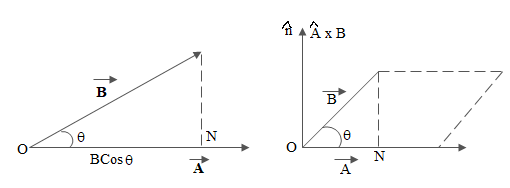
The vector product of two vectors [latex]\vec{A}[/latex] and [latex]\vec{B}[/latex] is a vector which is perpendicular to the plane of the vectors [latex]\vec{A}[/latex] and [latex]\vec{B}[/latex] and whose magnitude is ABSin[latex]\theta[/latex]. Where A and B are the magnitude of [latex]\vec{A}[/latex] and [latex]\vec{B}[/latex] and [latex]\theta[/latex] is the angle between [latex]\vec{A}[/latex] and [latex]\vec{B}[/latex].
Symbolically,
[latex]\vec{A}\times \vec{B}=ABsin\theta \hat{n}[/latex]
Where,[latex]\hat{n}[/latex] is the unit vector normal to both [latex]\vec{A}[/latex] and [latex]\vec{B}[/latex].

- [latex]\hat{i}, \hat{j}[/latex] and [latex]\hat{k}[/latex] are the unit vectors of a force along X, Y and Z axes respectively. Find the magnitude and direction of the vector product of two forces [latex]\vec{F_1}[/latex] and [latex]\vec{F_2}[/latex]. If [latex]\vec{F_1} = 3\hat{i}[/latex] and [latex]\vec{F_2} = – 2\hat{k}[/latex].
Solution:
Here, [latex]\vec{F_1} = 3\hat{i}[/latex] and [latex]\vec{F_2} = – 2\hat{k}[/latex]
[latex]\therefore \vec{F_1} \times \vec{F_2} = 3\hat{i} \times (- 2\hat{k}) = 6\hat{j}[/latex]
The plane of [latex]\vec{F_1}[/latex] and [latex]\vec{F_2}[/latex] (the [latex]\hat{i} – \hat{k}[/latex] plane) is perpendicular to the direction of [latex]\vec{F_1} \times \vec{F_2}[/latex] (the [latex]\hat{j}[/latex] direction). - If [latex]\vec{A}[/latex] and [latex]\vec{B}[/latex] are non zero vectors, is it possible for [latex]\vec{A} \times \vec{B}[/latex] and [latex]\vec{A}.\vec{B}[/latex] both to be zero? Explain.
Ans:
We know,
[latex]\vec{A} \times \vec{B} = ABsin\theta \hat{n}[/latex]
Or, 0 = [latex]ABsin\theta \hat{n}[/latex]
i.e. either A = 0 or B = 0 or Sin[latex]\theta = 0[/latex] ………………….. (i)
Also, [latex]\vec{A}.\vec{B} = ABcos\theta[/latex]
Or, 0 = ABCos[latex]\theta[/latex]
i.e. either A = 0 or B = 0 or cos[latex]\theta[/latex] = 0 ……………………….. (ii)
If [latex]\vec{A}[/latex] and [latex]\vec{B}[/latex] are non zero vectors, from equations (i) & (ii), it follows that [latex]\sin\theta[/latex] and [latex]\cos\theta[/latex] both should be zero simultaneously, which is impossible. - [latex]\vec{C}[/latex] is the vector sum of [latex]\vec{A}[/latex] and [latex]\vec{B}[/latex] i.e. [latex]\vec{C} = \vec{A} + \vec{B}[/latex] for C = A + B to be true, what is the angle between [latex]\vec{A}[/latex] and [latex]\vec{B}[/latex]?
Ans: Let, [latex]\theta[/latex] be the angle between [latex]\vec{A}[/latex] and [latex]\vec{B}[/latex].
We know,
C2 = [latex]\vec{C}.\vec{C}[/latex]
= [latex](\vec{A} + \vec{B})(\vec{A} + \vec{B})[/latex]
= [latex]\vec{A}.\vec{A} + \vec{A}.\vec{B} + \vec{B}.\vec{A} + \vec{B}.\vec{B}[/latex]
= A2 + ABcos[latex]\theta + BAcos\theta + B^2[/latex]
Or, C2 = A2 + B2 + 2ABCos[latex]\theta[/latex] ………………… (i)
Again, we have,
C = A + B
Or, C2 = (A + B)2
Or, C2 = A2 + B2 + 2AB …………….. (ii)
Comparing equations (i) and (ii), we get,
cos[latex]\theta = 1[/latex]
Or, [latex]\theta = cos^{-1}(1) = 0^o[/latex]
[latex]\therefore[/latex] Angle between two vectors is 0o, i.e. they are acting in the same direction. - The magnitude of two vectors are 3 and 4, and their product is 6. What is the angle between them?
Ans: Let, a and b be the magnitude of two vectors [latex]\vec{a}[/latex] and [latex]\vec{b}[/latex] respectively. According to the question, we have a = 3, b = 4 and [latex]\vec{a}.\vec{b} = 6[/latex] (Note that the product of [latex]\vec{a}[/latex] and [latex]\vec{b}[/latex] can’t be vector product i.e. [latex]\vec{a}\times \vec{b}[/latex]. This is because [latex]\vec{a}\times \vec{b}[/latex] is a vector but in accordance to the question the product is a scalar i.e. 6).
[latex]\therefore abcos\theta[/latex] = 6, [latex]\theta[/latex] is the angle between [latex]\vec{a}[/latex] and [latex]\vec{b}[/latex].
Or, 3 x 4 cos[latex]\theta = 6[/latex]
Or, cos[latex]\theta = \frac{1}{2}[/latex]
[latex]\therefore \theta = 60^o[/latex]
Hence, the required angle is 60o. - What is the difference between scalar and vector product of two vectors? Explain.
Ans: Following are differences between scalar and vector products of two vectors.
| Scalar Product | Vector Product |
| Scalar product of two vectors [latex]\vec{A}[/latex] and [latex]\vec{B}[/latex], denoted by [latex]\vec{A}.\vec{B}[/latex] is given by [latex]\vec{A}.\vec{B} = ABcos\theta[/latex] | Vector product of two vectors [latex]\vec{A}[/latex] and [latex]\vec{A}[/latex], denoted by [latex]\vec{A}\times \vec{B}[/latex], is given by [latex]\vec{A}\times B = ABsin\theta \hat{n}[/latex] , where [latex]\hat{n}[/latex] is unit vector which is given by right hand screw rule. |
| It is also called dot product. | It is also called cross product. |
| It is a scalar quantity | It is a vector quantity. |
| Scalar product of two vectors follows the commutative law. [latex]\vec{A}.\vec{B} = \vec{B}.\vec{A}[/latex] | Vector product of two vectors doesn’t follow commutative law. [latex]\vec{A}\times \vec{B} \neq \vec{B}\times \vec{A}[/latex] |
| Scalar product of two equal vector is square of the magnitude of either vector. i.e. [latex]\vec{A}.\vec{A} = A^2[/latex] | Vector product of two equal vector is zero. i.e. [latex]\vec{A}\times \vec{A} = 0[/latex] |
| Scalar product of two perpendicular vectors is zero. | Magnitude of vector product of two perpendicular vectors is equal to the product of magnitude of each vector. |
| Scalar product of two vector is the product of magnitude of projection of either vector on another vector and magnitude of another vector. | Magnitude of the vector product of two vectors represents the area of the parallelogram bounded by these vectors. |
Finished studying this chapter resource?
Mark this chapter as complete to update your course progress.